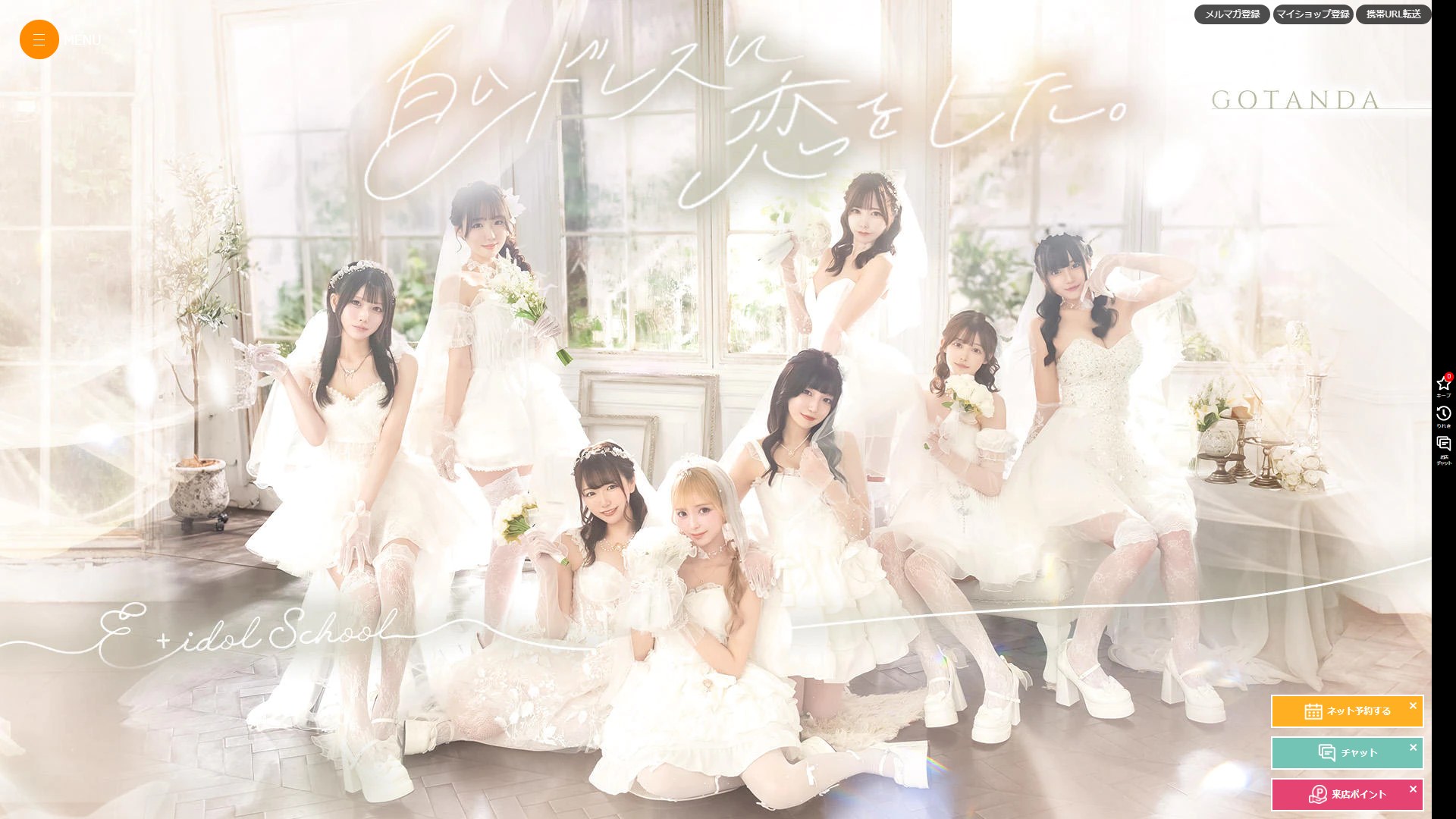

Gotanda's E+ Idol School Gotanda-ten is a school-themed, school-idol-style delivery health (deriheru) shop that bills itself with "the ultimate idol who becomes your oshi" and "Meet her now! Back her now!" Its roster is built around the concept of "idols-in-the-making," girls in their teens to early twenties.
What drew me to this shop wasn't the youth of the girls or the school-themed format. It was that they put "oshi" right on the marquee. As adult-shop copy, that's actually a pretty bold choice.
"Nomination" and "oshi" open the customer's wallet differently
The word a regular delivery health shop uses is "nomination" (shimei) — requesting a specific girl. A nomination is an act aimed at making that single day's session better; the gaze is basically fixed on "today's play."
But "oshi" runs on a different timeline. In idol culture, your "oshi" is the one you support continuously, keep visiting, keep spending on. It's a word that assumes you're building a relationship, not chasing a single payoff. The fact that this shop chose "oshi" over "nomination" reads, to me, as a declaration of intent: they want to design the customer as a repeat visitor, not a one-and-done walk-in.
And in fact, the fee structure backs that up. The nomination fee is tiered — ¥2,000 by photo, ¥3,000 for a repeat-nomination (requesting the same girl) — and they even have a point card. It's a structure where the more you keep running "repeat nominations," the more locked into the shop you become. Concept and billing design point cleanly in the same direction.
How to correctly read the "idol-in-the-making" copy
School-themed and idol-style copy spikes a customer's expectations in one shot. But break it down soberly, and "idol-in-the-making" also means "not yet an idol." Confuse the two and you'll be let down.
What you should expect is not a polished service pro, but the atmosphere that comes from freshness, openness, and youth. Put another way: it's not for the customer who wants the steady, seasoned attentiveness of a veteran or smooth, practiced conversation. This shop's value isn't a "finished product" — it's getting to "be present for the process of growing up." That's exactly why it's "oshi." The structure is built on backing them before they've bloomed.
Walk in with that understanding, and even the stiffness of a young girl's service reads as "room to grow." Read the concept correctly and you can control the satisfaction design from your own side.
Course design — starting at 60 minutes / ¥18,000, how do you stack it?
Pricing starts at 60 minutes for ¥18,000 (¥15,000 with the discount applied), then steps up: 75 minutes ¥21,000, 90 minutes ¥26,000, 120 minutes ¥34,000, with a 30-minute extension at ¥10,000. You build the total together with the nomination fee.
Since school-themed and idol-style shops put the weight of their value on "conversation and atmosphere," 60 minutes is a touch rushed. Time can run out before a young girl's nerves loosen up. If you just want to scope out the shop's vibe on a first visit, 60 is fine — but if you're going in to build a relationship as her "oshi," 75 or 90 minutes meshes better with the concept. Think of it as buying the time it takes to warm up through conversation.
Hours are 10 a.m. to 5 a.m. Gotanda has hotels packed right by the station, so if you trim the loss between meeting up and getting into the room, even a shorter course makes it easy to bank actual working time.
The gap on photo-nominations, and the difficulty of picking young girls
Young cast members have a wide spread between photo and reality. They're more affected by editing, and their impression shifts with the day's condition (nerves, health). School-themed shops especially tempt you to pick by "cuteness in the photo," but go all-in on a photo-based nomination here and you'll get jerked around by the gap.
What I look at with this kind of shop is the wording in the photo-diary (shameru nikki). Youth shows up in the writing too. Is it a sentence reaching to sound grown-up, or one written plainly as themselves? Girls who write plainly tend to give you unembellished service on the day as well. Since the charm of school-themed shops lies in that "unembellished" quality, prioritizing it over the photo when you pick makes you a lot less likely to miss.
Wrap-up
| Category | Score | Comment |
|---|---|---|
| Concept consistency | ★★★★☆ | "Oshi" and the billing design (nomination fee, points) line up |
| Ease of calibrating expectations | ★★★☆☆ | "In the making" = unfinished. Understand it and you're satisfied; misread it and you're let down |
| Course design | ★★★☆☆ | 60 minutes is rushed. The real worth shows at 75–90 |
| Location / time efficiency | ★★★★☆ | Gotanda's hotel density lets you bank working time |
| Built for repeat visits | ★★★★☆ | Optimized for the "regular" over the one-timer |
E+ Idol School Gotanda-ten is one of the few school-themed shops that doesn't let "oshi" be empty marquee talk. The tiered nomination fees and the point card are both machinery for getting customers to "keep coming," with no contradiction against the concept. So if you measure this shop as a one-off thrill, you'll misjudge it. Being present for youth before it blooms and stacking up a relationship — for the customer who can choose to play it that way, it's exactly the shop the copy promises. The answer to "what happens when you bring your oshi into the adult world" is: "the billing gets rewired around continuity." If you can step in knowing that, I'd call it an interesting spot in Gotanda.