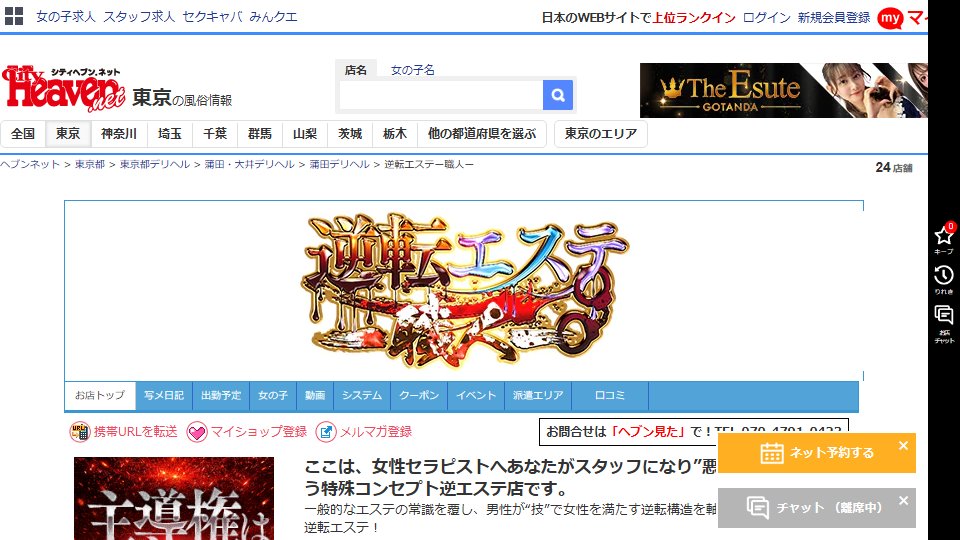

Let me be exact about what Gyakuten Esthe Shokunin — 逆転エステー職人ー — is, because the name is doing all the heavy lifting and most people will skate right past it. It's a delivery operation, an image-club-style fuzoku esthe that comes to you — no shopfront, you call and she comes to a hotel room in Kamata, the working-class terminal down in Ota Ward at the southern hem of Tokyo, the last big station before the city gives way to Kawasaki. And the concept is right there in the two front words. 逆転 — gyakuten — reversal. 職人 — shokunin — craftsman. In a normal fuzoku esthe, a female therapist is the practitioner and you're the body on the table. Here it's inverted: you are cast as the staff, the one running the session, and the woman plays the client. I went down to Kamata to see whether that inversion is a real product or just a poster.
The Inversion Is the Whole Product
Start with what almost nobody stops to notice: the entire industry runs on one unspoken default — the customer receives. Every menu you've ever read is a list of things done to you. Shokunin takes that default and turns it a full 180. The pitch is that you're the practitioner conducting the session — the copy leans into "training" the therapist rather than being tended by her. Strip the theater off and the economic claim underneath is sharp: they're not selling a better version of being served, they're selling the opposite side of the table. That's not a small tweak. It's a different appetite entirely, and a shop that builds its whole brand around it is betting there's a real, underserved population of men who are tired of being the passive body and want, for seventy minutes, to be the one with the hands and the plan. Naming yourself after the worker is the confession: the fantasy on sale is agency, not pampering.
Why Kamata, and Why Delivery
Here's the part a downtown snob misreads as second-best. Running a niche role-reversal concept out of Kamata instead of Kabukicho isn't settling — it's the only place the math works. A concept this specific has a thin, scattered audience; you can't fill a fixed premium storefront with it every night without bleeding out on rent. So you go delivery — no premises ticking against an empty room, just a woman on-call and a car — and you plant it in a dense, unpretentious terminal like Kamata where the hotels are plentiful, the crowd is local and unfussy, and the overhead is a fraction of central Tokyo. The delivery model is what lets a narrow concept survive at all: it turns "not enough demand to fill a shopfront" into "exactly enough demand to keep a phone ringing." Kamata isn't where the idea got exiled. It's where the idea can actually pay rent.
Two Courses, Two Different Products
Now the pricing, because this is where the shop tells you the truth about itself. There are two ladders, and they are not the same product at two intensities — read them as two doors. The soft course runs 70 minutes ¥16,000, 90 minutes ¥24,000, 120 minutes ¥30,000. The hard course runs 70 minutes ¥19,000, 90 minutes ¥28,000, 120 minutes ¥38,000, and tops out at a 180-minute set for ¥50,000 the soft menu doesn't even offer. Same clock at the entry rung — seventy minutes either way — but a ¥3,000 gap and a whole extra three-hour tier that only exists on the hard side.
Read that structure, because it's legible in a way most shops aren't. The soft course is the on-ramp — a capped-downside ¥16,000 for the man who's curious about the reversal but wants to test whether the "craftsman" fantasy is real before he commits. The hard course, and especially that ¥50,000 three-hour set, is built for the man who already knows he wants it and wants room — the reversal doesn't pay off in a hurried twenty minutes; the whole point of playing the practitioner is having enough clock to run the session at your own pace. The fact that the long tier lives only on the hard menu is the shop being honest that its deepest product is a time product, not an intensity product. On top of the ladders sit à-la-carte options — cosplay around ¥2,000, all-nude around ¥4,000, a 30-minute extension around ¥12,000 — legible add-ons, not a bait ladder. This is a menu that respects that its two buyers want two different things and refuses to pretend they're the same guy.
The Eighteen-Hour Clock and the Caveat
Two structural notes. The door runs noon to 6:00 the next morning, every day, no fixed holiday — an eighteen-hour clock, and for a delivery shop that low marginal cost of staying open late is pure harvest: the after-work wave, the last-train-missed contingent stranded in Kamata's hotels with time to burn. A house answering the phone at 3 AM is eating demand its earlier-closing rivals leave on the table.
The caveat is the one every concept house wears. A role-reversal shop is a casting problem before it's anything else — the reversal only works if the woman can actually hold the "client" role convincingly and read the room while you run the session. That's a specific skill, thinner on the ground than standard fuzoku-esthe casting, so the bench is smaller and the best-matched performers cluster in the prime windows. You're buying a snapshot of who's on-call tonight, not a standing lineup. Know that going in.
The Verdict on the Reversal
- Concept clarity: ★★★★★ — "reverse esthetic, you're the craftsman" is a real, specific inversion, not adjectives; the shop knows the exact narrow thing it sells and named itself after it.
- Price honesty: ★★★★☆ — two legible ladders (soft ¥16,000/¥24,000/¥30,000, hard ¥19,000/¥28,000/¥38,000/¥50,000) that admit they're two different products; add-ons are transparent, no trap-door trial number.
- Value (for the right buyer): ★★★★★ — if you're specifically tired of being the passive body and want the agency side of the table, nothing on a standard menu gives you this; the delivery overhead keeps it affordable.
- Access / hours: ★★★★☆ — eighteen-hour clock and a delivery model that owns Kamata's hotel-dense catchment; standard prime-time-bench caveat applies.
- Going back: ○ — the soft course makes the first test cheap; the hard course's long tier is where the concept actually pays off, so the real second visit is a hard-course booking.
I went down to Kamata to find out whether "you're the craftsman" was a costume or a product, and the fair verdict is that it's a product — the rare kind that flips the one verb the whole industry takes for granted. This isn't the shop for the man who wants to lie down and be tended; that man has ten thousand other doors and should walk through any of them. It's the shop for the man who's done being the body on the table and wants, for once, to be the one holding the tools. The soft course is how you find out if that's you; the hard course, and that three-hour set, is where you'd go once you know. Session logged, and the reversal — read closely — is load-bearing.