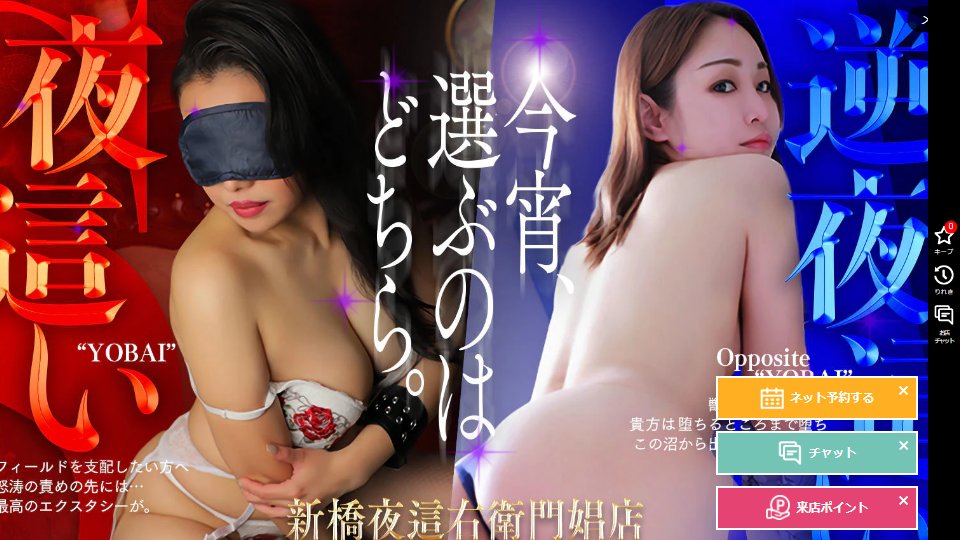

Shimbashi is the most honest neighborhood in Tokyo. It's the salaryman's town — the red-lantern izakaya under the tracks, the loosened ties, the guys nursing a highball at 11 PM because the last train home means the day isn't over yet. It's a place that runs on tired men and the small mercies they buy at night. So when I found a delivery health here built entirely around a fantasy — not a body type, not a discount, a fantasy — I wanted to see whether it delivered the story or just the girl. The shop is Shimbashi Yobai Uemon Shouten, a married-women deriheru whose entire concept is yobai — the old Japanese night-crawl, where the man slips into the room of a sleeping woman. I'm a New Yorker; I've seen theme bars promise the moon and hand you a warm beer. I went in expecting the concept to be wallpaper. It wasn't.
The Premise Is the Product
Let me be clear about what "yobai roleplay" means here, because the shop doesn't hide it and neither will I. The pitch is a scripted night-assault fantasy: the woman playing asleep, and — if you opt into it — a blindfold and handcuffs in the mix. It's cosplay for a specific corner of the imagination, and the reason it works is that everyone involved knows it's theater. This is Japan's married-women lane, so the women are cast as hitozuma — the sleeping-wife premise is the whole architecture of the thing. What impressed me on the phone was that reception treated the concept like a menu, not a gimmick. They asked what I wanted the scene to be, how far into the roleplay I wanted to go, whether the props were in or out. A shop that actually runs its own concept asks those questions. A shop that slapped "yobai" on a banner to stand out doesn't know to.
Shimbashi at Night, and How the Call Works
This is delivery health, so there's no shopfront to walk into — you book, they dispatch, you meet at your hotel or place. The shop runs out of the Shimbashi / Shiodome side, nearest the Karasumori exit, and covers all 23 wards of central Tokyo. If you're right in Shimbashi the transport fee is free; step out to Minato, Chiyoda, or Chuo and it's ¥1,000; farther into the 23-ward sprawl and it tiers up to around ¥5,000 depending on distance. The hours are the real tell of who this place is for: 10 AM to 3 AM, year-round, no days off. That's not a shop chasing the dinner crowd. That 3 AM close is built for exactly the Shimbashi archetype — the man who missed his last train, who's got a capsule hotel or a business room and a few dark hours to fill before the first train back. I called late-ish on a weeknight. Reception was fast and flat, no upsell theater, and the dispatch timing they quoted held.
The Numbers, Read Cold
Here's the board as I read it, and I only quote what I could actually confirm. The headline course is 60 minutes, listed at ¥20,000 regular — but the shop runs a standing 35% discount that drops it to ¥14,000, and there's a coupon 65-minute course also landing at ¥14,000. For a first-timer they steer you toward the 80-minute course, and the logic is sound: a concept shop needs runway. A yobai scene has a setup, a build, and a payoff — the sleeping premise, the slow approach, the reveal — and trying to cram that arc into a bare 60 is like watching a heist movie on fast-forward. You feel the shape but you miss the tension. The transport fee sits on top per the zone tiers above. Do the arithmetic: fourteen grand plus a thousand-yen dispatch for a genuinely staged 65 minutes in central Tokyo is not a premium ask. It's a fair one, and the discount isn't a bait number — it's just how the shop prices.
What the 80 Actually Buys
Because the whole thing is built on a script, the length isn't filler — it's structure. Taking the longer block meant the setup got to breathe: the room dim, the premise established, the woman committing to the sleeping-wife role instead of dropping character the second the door closed. The married-women casting matters here, because the whole illusion depends on someone who can play lived-in rather than performing surprise. And once the blindfold went on — my choice, offered not imposed — the shop's real trick showed itself. Stripped of sight, the ordinary geometry of a delivery-health encounter turned into something with suspense in it. That's the payoff a concept shop is selling and most can't deliver: not more, but shaped. I've done plenty of straight-ahead deriheru where you get exactly what the menu says and nothing more. This was the rarer thing — a shop that had an idea and actually executed it.
Verdict: The Concept Holds
- Concept execution: ★★★★★ — the yobai premise is real, run by staff who know their own script.
- Married-women casting vs. the story: ★★★★☆ — cast for the role, not just the category; the illusion held.
- Reception & dispatch: ★★★★☆ — quick, honest, asked the right roleplay questions.
- Value at ¥14,000: ★★★★☆ — fair for a genuinely staged session in central Tokyo.
- Going back: ◎ — and next time I'm booking the 80 without hesitating.
Shimbashi is the right home for this shop, and not by accident. It's a neighborhood full of men who spend their days being exactly who they're supposed to be, and a place like Yobai Uemon Shouten sells the one thing that district doesn't hand out for free after midnight — a scene where, for 65 or 80 minutes, you get to be someone else entirely. The blindfold, the cuffs, the sleeping-wife premise: it sounds like a gimmick until you're in it and realize the shop actually knows how to run the thing it's selling. First visit, cold, no expectations — and the premise held all the way through. In this trade that's rare enough to write down. If you're going to do a themed deriheru in Tokyo, do one that means it. This one means it.