
Let me be exact about what Chloe Kinshicho — Chloe錦糸町店 — actually is, because the sign over the door is doing double duty and you should see both jobs it's working. It's a デリヘル, a delivery health, a deriheru — no storefront, no lobby, you phone in and she comes to your hotel room — operating in Kinshicho, in Sumida Ward on Tokyo's east side, the brash terminal on the Sobu line that the west-Tokyo crowd forgets exists. And it's not an independent. It's a branch of the Chloe group, a chain running something like sixty shops, casting itself as an "S級素人清楚系デリヘル": S-class amateur, seiso — clean-cut, demure, wholesome-looking — delivered to your door. The tell is in the fine print: this branch is monitored from the Chloe Gotanda main branch across town. That single line is the whole story. I went to Kinshicho to read what a franchise actually sells.
The Brand Is a Promise About Variance, Not About a Place
Start with the word most men skip: chain. A sixty-shop group doesn't scale by getting lucky sixty times. It scales by writing down what "a Chloe girl" means — the look, the manner, the seiso register — and then enforcing that spec at every branch until the customer in Kinshicho gets the same casting logic as the customer in Gotanda. The brand isn't promising you this neighborhood. It's promising you the neighborhood doesn't matter. That's the entire value proposition of a chain, and it cuts both ways. The upside: no nasty surprises, because head office already filtered out the outliers. The downside: no delightful surprises either, because the same filter that kills the misses also flattens the peaks. When you book Chloe Kinshicho, you are explicitly trading the ceiling of a wildcard independent for the floor of a standardized one. Whether that's a good trade is a question about you, not about the shop.
Why "Seiso" Is the One Spec That Survives Replication
Here's the part that's genuinely clever, and it's why "S級素人清楚系" isn't just adjectives stapled together. Of every casting angle a deriheru can sell, "clean-cut amateur" is the single most replicable one — and a chain lives or dies on replicability. Think about what a franchise can't standardize: it can't mass-produce genuine star charisma, can't bottle a specific woman's chemistry, can't scale "unforgettable." Those are peaks, and peaks don't franchise. But seiso — the demure, girl-next-door, could-be-a-normal-office-worker register — is a look and a manner, and looks-and-manner is exactly what a casting standard can enforce across sixty locations. Head office can write "we recruit the wholesome type, not the flashy type" into the playbook and actually make it stick, branch after branch. So the chain didn't pick "seiso" because it's the most exciting product. It picked it because it's the most manufacturable one — the casting spec that reliably clears the same bar in Kinshicho as in Gotanda. The concept and the business model are the same decision. That's not lazy. That's a company that understands its own constraints.
The ¥16,000 First Set Is a Chain Price, Not a Neighborhood Price
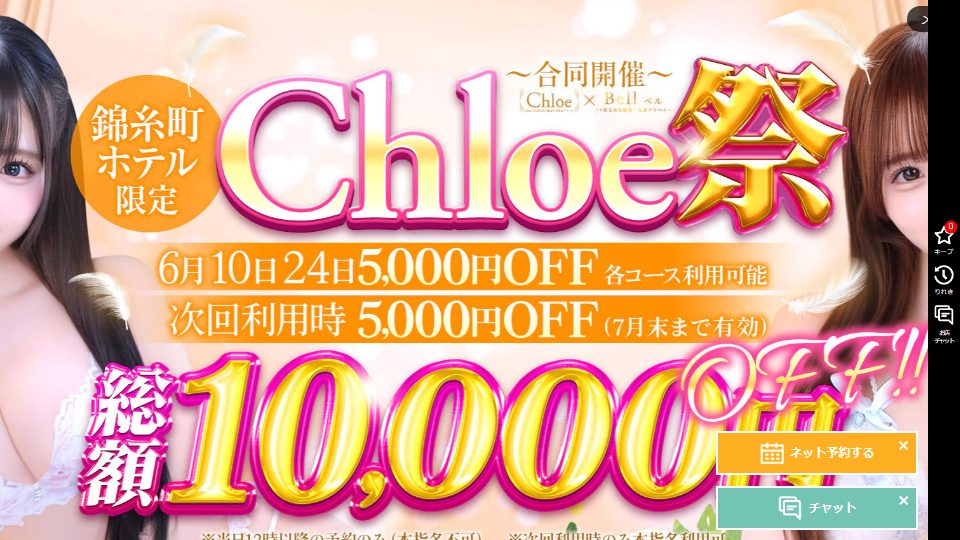
Now the money, and this is where the franchise logic gets concrete. The Kinshicho first set lands around ¥16,000 all-in for 60 minutes — course plus transport — off the back of a new-customer discount reported around ¥4,000, with the group also running a headline ¥10,000-off event, preview-booking cuts, transport covered up to ¥3,000, and review cashback. Read that stack for what it is: these are not prices Kinshicho set. These are prices the chain set. A sixty-shop group runs one promotional machine and points it at every branch — the same new-customer hook, the same transport subsidy, the same review-cashback flywheel, tuned centrally and deployed everywhere. That's why the number in Kinshicho rhymes with the number in Gotanda: they came out of the same pricing office. The upside for you is real — a chain's promo budget is bigger than any independent's, so the on-ramp discounts are deeper and the transport coverage is genuine, not a bluff. Just don't mistake the ¥16,000 for a Kinshicho bargain. It's a chain acquisition cost, engineered to get a first-timer through the door of any Chloe branch and into the review-cashback loop that feeds the group's ranking. The discount is real. The thing it's buying — your first data point in their funnel — is worth more to them than the ¥4,000 costs.
The Long Clock and the Roster Caveat
Two structural notes before the verdict. The door runs noon to 6:00 the next morning with booking lines opening around 1:00 PM — an eighteen-hour clock, and in Kinshicho that's not incidental. This is a nightlife-heavy east-Tokyo terminal with a hard-drinking after-hours rhythm; a delivery model's marginal cost of staying open past the last train is near zero, so the shop answering at 3 AM is harvesting the missed-train, still-out crowd its earlier-closing rivals wrote off. And the roster caveat is the standard one, sharpened by the chain structure: a sixty-shop group's bench is deep in aggregate but any single branch's lineup on a given night is a snapshot, not a catalog — the names rotate, the best-reviewed ones cluster in prime windows, and "the group has great girls" is not the same claim as "Kinshicho has great girls tonight." Book the branch, but nominate the person; the chain guarantees the floor, not the specific face.
The Verdict on the Franchise
- Concept clarity: ★★★★☆ — "S-class amateur, seiso" is a real, enforceable casting spec, and picking the one register that actually franchises is a coherent decision, not a slogan.
- Chain consistency: ★★★★☆ — a named oversight structure (Gotanda monitoring the branches) and a central promo machine mean low variance and a genuine floor; you're buying the elimination of surprises, up and down.
- Price honesty: ★★★★☆ — the ¥16,000-ish first set and the discount stack are real and chain-funded, deeper than an independent could run; just read them as acquisition cost, not neighborhood pricing.
- Access / hours: ★★★★☆ — an eighteen-hour clock into the small hours suits Kinshicho's late east-side rhythm and owns demand the early-closers leave behind.
- Going back: ○ — the on-ramp and the review loop make a second visit frictionless; the chain floor means the return won't disappoint, and also won't stun.
I went to Kinshicho to read a franchise, and the fair verdict is that Chloe Kinshicho is exactly what a good chain branch should be: a faithful copy of a standard, priced by head office, casting to the one register — seiso — that survives being replicated sixty times. The "monitored from Gotanda" line isn't filler; it's the company telling you it knows where distributed operations rot and claims to be watching. This isn't the shop for the man hunting the wildcard peak, the singular woman a one-off independent might randomly hand him — a chain sands those peaks off by design. It's the shop for the man who wants the floor guaranteed: east-Tokyo access, a clean-cut casting standard he can trust to clear the same bar it clears across town, and a chain-funded first set that caps his downside to sixteen thousand yen. First set logged, and the franchise, read closely, does what a franchise is supposed to do — it makes the neighborhood stop mattering.