
Doubting the "Shinagawa Ranking No.1" Symbol
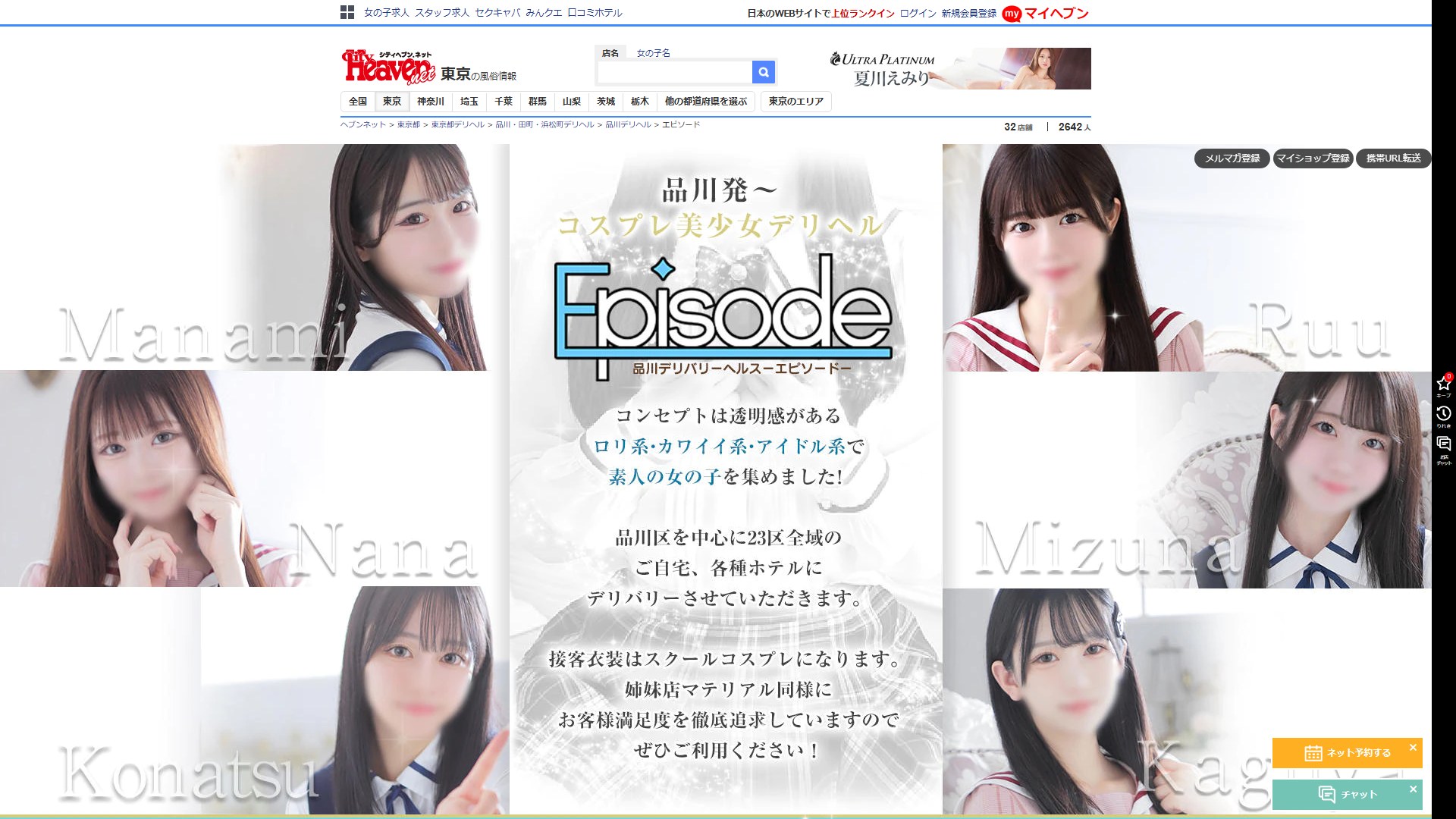
Episode (Shinagawa)'s tagline is "👑Shinagawa Ranking No.1👑 cute-girls-only amateur delivery health (deriheru)." It's the textbook schoolgirl-style setup: amateur cute girls of the loli, cutesy, and idol types, dispatched with their own cosplay outfits in hand.
The "Ranking No.1" banner is one of the most thumb-worn phrases in the entire adult-industry marketing playbook. A platform's ranking moves however you like depending on the tallying period, the target area, and how the metric is taken. So I have no intention of taking the rank itself at face value. What I care about is elsewhere: the back end — how a shop that calls itself "amateur specialists" keeps a stable supply of those amateurs. The more amateur-focused a shop is, the harder its inventory management — that is, the turnover of girls and the maintenance of quality.
A Location That Covers Shinagawa, Tamachi, and Hamamatsucho From One Shop
The area covers Shinagawa, Tamachi, and Hamamatsucho. As a deriheru it doesn't keep a storefront, but covering a span across those three stations means it's designed to scoop up the entire business-district hotel demand. The nearest base point is around Gotanda. Hours run from 12:00 to 5:00 the next morning, open year-round.
That "from 12 noon" opening time matters. Shinagawa and Tamachi are towns of business travelers and corporate use, and there's a steady slice of customers who can move from midday. The fact that they're going after the daytime rather than running nights only shows the operation understands how demand surfaces. Without a physical box, a deriheru competes not on location but on "which hotel zone can I deliver to in how many minutes." A coverage span across three stations also means, flipped around, that the driver dispatch network is built out that much further.
How to Read the Early-Shift / Late-Shift Price Difference
Pricing is built on 60 minutes: the early shift (12:00–20:00) is ¥18,000, the late shift (20:00–5:00) is ¥19,000. No membership fee, no nomination fee — they push transparent pricing. Transportation runs ¥0 to ¥4,000 depending on the area.
What I want to flag here is the ¥1,000 spread between early and late shifts. This isn't a simple time-of-day discount; it's price design meant to flatten the demand peak. Price it a touch lower in the slow midday-to-evening hours to draw customers through, and take full price in the busy night. A shop that prices like this is managing its utilization rate by the numbers. A shop running on gut feel doesn't put in fine steps like that.
To talk practical: if you're trying schoolgirl-style or amateur-style for the first time, the early-shift ¥18,000 is the easier door. The midday window is right after the girls clock in, so they're less worn down and the energy of the service hasn't dropped. A free nomination fee also lowers the psychological hurdle of going in to land a "winner" on your first try. In a genre where a ¥2,000 nomination fee is the norm, making it free is a sound new-customer funnel.
Can "Amateur" and "Veteran" Coexist?
The most interesting thing about this shop is that it calls itself "amateur specialists" while sitting under the Material Group, founded in 2008 — so it has a veteran's operational backbone. Normally "amateur" and "veteran" make poor bedfellows. The amateur feel lives and dies on freshness, and the longer a shop runs, the more systematized it gets and the more the whiff of the manual creeps in.
But flip the view: lasting a long time also means they've kept the amateur supply line spinning for over a decade. Where amateur-style shops trip up most is when hiring can't keep pace with turnover and photos drift away from reality — the slide into "photo fraud." A group operation running since founding is the recruiting-and-training foundation that holds that line. The banner "amateur" guarantees freshness; the back-end "veteran" guarantees supply — if that two-layer structure holds, the tagline reads not as exaggeration but as a division of labor.
What "Bring-Your-Own Cosplay" Means as an Operation
"Dispatched with cosplay in hand" is plain, but operationally it's rational too. The schoolgirl and idol worldviews stand up on the costume. Set it up so the girl brings her own and heads over, and the customer is spared the trouble of preparing an outfit while the shop delivers the worldview without holding inventory in a box. It turns the constraints of the deriheru format into a strength of the concept.
That said, the costume is just the entrance. As I've written before, cosplay shops split into two: those where it ends at "just changing clothes," and those that can use the outfit as "the entrance to a performance." Which one Episode is comes down, in the end, to the skill of whichever girl shows up that day. Even with the banner and the system in order, what makes the final few dozen minutes land is the individual's service. That alone remains a zone no operational design can fully standardize.
The Verdict
| Category | Stars |
|---|---|
| Clarity of concept | ★★★★☆ |
| Rationality of price design | ★★★★☆ |
| Location / coverage span | ★★★★☆ |
| Ease of entry for new customers | ★★★★☆ |
| Reproducibility of a "winner" (needs verification) | ★★★☆☆ |
You don't need to take the "Shinagawa Ranking No.1" banner at face value. But look one by one at the system behind it — hours that go after the daytime, pricing with an early/late-shift step, a dispatch network across three stations, and a group supply base running since 2008 — and you start to see a shop that can build its rank through operations. Not a one-off No.1, but the foundation to keep aiming for a sustained No.1.
If you're trying amateur-style or schoolgirl-style for the first time in the Shinagawa area, going in at the early-shift 60 minutes for ¥18,000 with no nomination fee is, I think, the low-risk way to run the test. Contrary to the flashiness of the banner, the substance is a shop designed pretty soundly.