
First, Question the "Secretary" Motif
Hishoshitsu's tagline is "If you want to feel the grown-up luxury that top-tier beauties deliver, this is the place." Its concept: "The mark of a first-class operation is always seeking to evolve." Airtight wordsmithing, very much in the style of a high-end Yoshiwara soapland.
But the first thing that snags me is the "secretary" in the shop's name. In this business, "secretary" is too convenient a symbol. The suit, the polite speech, the refinement, and that sense of ownership—"yours exclusively"—all of it is cheap to stage. A single cosplay outfit and you've got "secretary play" up and running. Which is exactly why a genuinely high-end shop is separated from the rest by one question: how seriously does it actually run the secretary premise? Is it a shop where the concept ends at the change of costume, or one that bakes it into the very conduct of the service? That's my test today.
What the Yoshiwara/Senzoku Location Tells You
The shop sits in 4-chome Senzoku, Taito-ku, Tokyo. Within Yoshiwara's soapland district, it's one street off the main drag—a quieter pocket. The nearest stations are Nippori on the JR Yamanote Line, Iriya/Minowa/Minami-Senju on the Hibiya subway line, Tawaramachi on the Ginza line, and Asakusa on the Tobu line. Wherever you come from, it's a bit of a walk from the station—that's just the structure of Yoshiwara as a district, and it's exactly why so many high-end shops run a pickup service.
Hishoshitsu advertises a free pickup service too. For a high-end soapland, this carries more meaning than mere convenience. Offering pickup is a courtesy—"we won't leave the customer lost on the street"—and at the same time an operational defense: "we won't let customers go snooping around for the shop's location." A shop that arranges pickups smoothly is proof the back-of-house operation is dialed in. Conversely, a shop that touts pickup but fumbles the logistics has a back end that isn't turning, no matter how impressive the front-facing concept.
Pricing—How a Shop That Calls Itself "Top-Tier" Sets Its Numbers
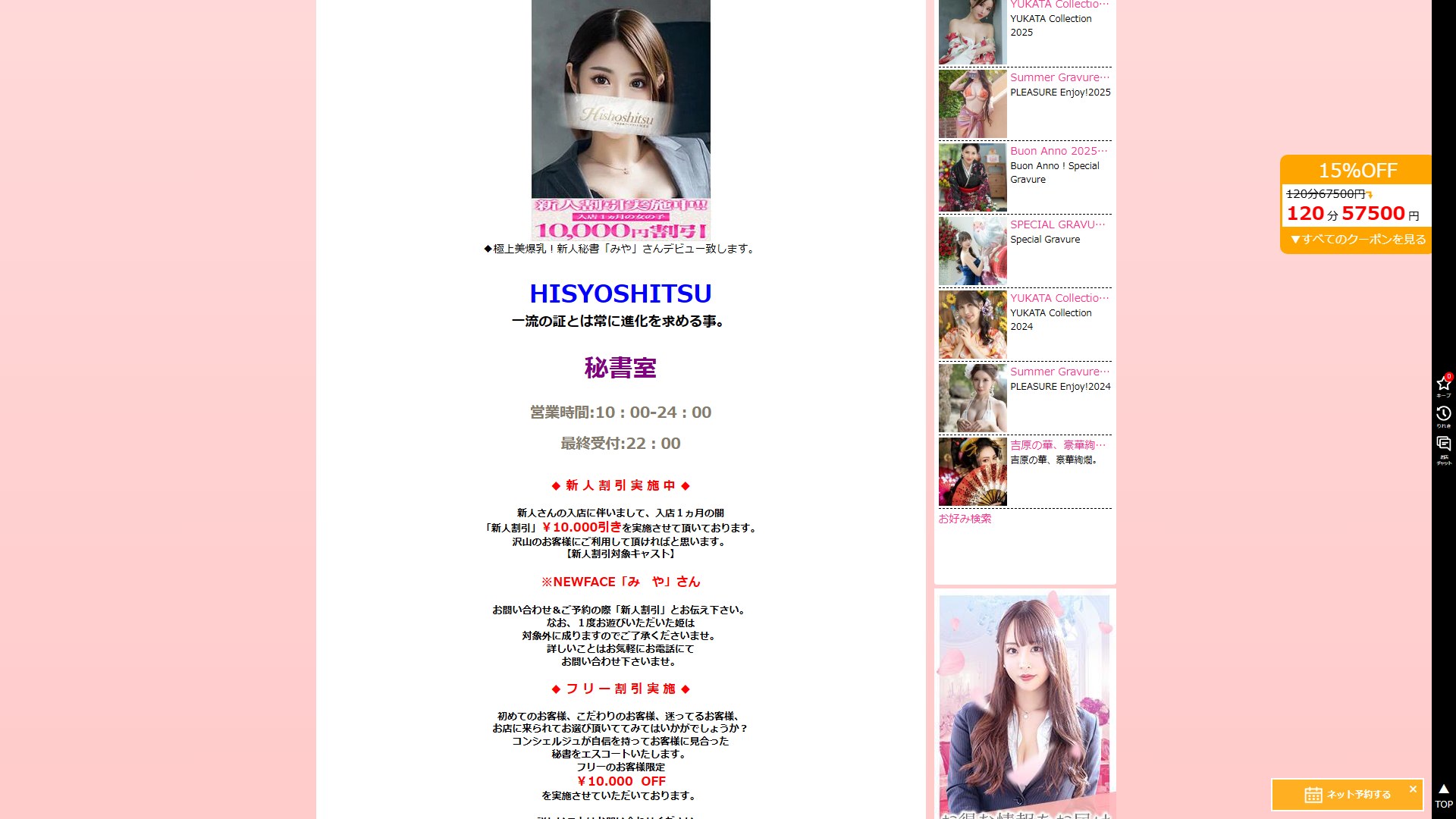
The baseline listed on the page was 120 minutes for ¥67,500. Stack on the 15% coupon and it drops to ¥57,500, plus a ¥10,000-off new-staff discount and a ¥10,000-off free (no-nomination) discount on offer. Hours are 10:00 to 24:00, last booking at 22:00. Pickup is free.
Let me lay one thing out. A Yoshiwara soapland billing itself as "high-end" is a business where the total swings hugely depending on the time slot you enter, the course, and whether you nominate. So clipping out just the "120 minutes for ¥67,500" baseline and pronouncing it cheap or expensive is premature—in practice the final bill moves with discount eligibility, nomination fees, extensions, and so on. I'm not going to assert anything beyond what's stated on the page. What's certain is that it permanently advertises a two-pronged discount: a new-staff discount and a free discount.
This discount design is worth reading. The new-staff discount is built to "fill seats with freshly hired girls"; the free discount is built to "pull in walk-in customers who come without a nomination." Both are textbook moves for boosting turnover. Calling itself high-end while widening the door with free and new-staff slots—in other words, this is a shop running both "exclusivity" and "easy entry" at once. Rather than piling up a full nomination bill on your first visit, the right way into this shop is to use the free discount once and verify the "pedigree" for yourself.
The Conduct at Reception Reveals Whether the Shop Means It
The first thing I look at in a high-end shop isn't the girl—it's reception. The phone manner, the greeting on arrival, the fluency of the pricing explanation. Once you bill yourself as "top-tier," the sign collapses the moment sloppiness shows here.
At the inquiry stage, do they organize the fee structure and the discount eligibility conditions into clear words and hand them back to you? Do they answer what you asked—no more, no less—without muddying the roster or the system? A shop that has these basics down runs its floor at the same temperature. Conversely, a shop that tries to end the call with "we'll explain when you get here" usually has something it doesn't want to explain. A shop like Hishoshitsu, which sells "pedigree," lives or dies on the transparency of this entry point.
How to Read the "Always Seeking to Evolve" Concept
The concept: "The mark of a first-class operation is always seeking to evolve." It sounds abstract, but recast it in soapland terms and the meaning surfaces. For a high-end soapland, "evolution" isn't about bolting on flashy new services. It's about continuously maintaining the quality of the roster, keeping the facilities clean, and constantly updating the conduct of service—in other words, the deeply unglamorous staying power of "never letting the baseline drop."
Permanently advertising a new-staff discount can be read as an expression of this "always evolving = always continuing to recruit new girls" posture. When a shop that claims to hire only the highest-caliber women never runs dry of newcomers, it means it's churning a large enough recruiting pool and selection process to do so. This is a spot where the self-billing and the operation line up—and that earns credit.
The Direction of the Service—The Temperature of a Shop That Sells "Healing"
On the service side, what the shop puts forward is "relaxation and bliss, to your heart's content." Not intensity, not edginess—it's pitched at the temperature of healing and luxury. This is the royal road of the high-end soapland, and you can read the clientele as the "take your time" crowd rather than the "get it over with quickly" crowd. Anchoring the baseline at a 120-minute slot backs that up.
In this type of shop, satisfaction hinges less on flashy technique than on "how pleasant the flow of time is." Not being rushed, not being treated carelessly, careful through to the end—that accumulation is the substance of the word "luxury." If Hishoshitsu lives up to its sign, this is where the core of the evaluation concentrates. Put the other way: if this part is sloppy, "top-tier" is just a price tag.
Summary
| Category | Rating |
|---|---|
| Location & access | ★★★☆☆ (far from the station, but covered by free pickup) |
| Pricing clarity | ★★★★☆ (baseline price + the two-pronged new-staff/free discount is clear) |
| Concept consistency | ★★★★☆ ("evolution = continued recruiting" aligns with the discount design) |
| Style & temperature | ★★★★☆ (an orthodox high-end soapland pitched at healing and luxury) |
| Ease of a first visit | ★★★★☆ (you can test the "pedigree" first with the free discount) |
The verdict. Hishoshitsu's "top-tier" was not, at least at the design level, a euphemism for a price tag. The pickup, the discounts, and the concept don't pull in separate directions—they converge into a single strategy: "widen the door while preserving the pedigree." For anyone trying a high-end Yoshiwara soapland for the first time, using the free discount to check that "rhythm" once is not a bad way in.
That said, whether it truly runs the "secretary" motif to the hilt—whether there's a consistent quality from the conduct at reception all the way to seeing you off—is ultimately something you can only confirm with your own eyes. Question the sign, test it at the door, and judge by the flow of time. The right way to savor a high-end soapland always comes down to exactly that.