
Kanda at eight in the evening is one of the last honest neighborhoods in central Tokyo. Two stops from Tokyo Station, no tourists to speak of, no scramble crossing, nobody filming anything for anybody's feed. What it has is office buildings that empty at seven and izakaya that fill at seven-fifteen, and men in white shirts with their jackets over one arm standing outside them arguing about which floor to go to next. The west exit is the loud side. Under the JR viaduct the yakitori smoke goes sideways in the draft from the trains, and above it, on the fourth and fifth and sixth floors of buildings whose ground floors sell reading glasses and set lunches, is the other Kanda.
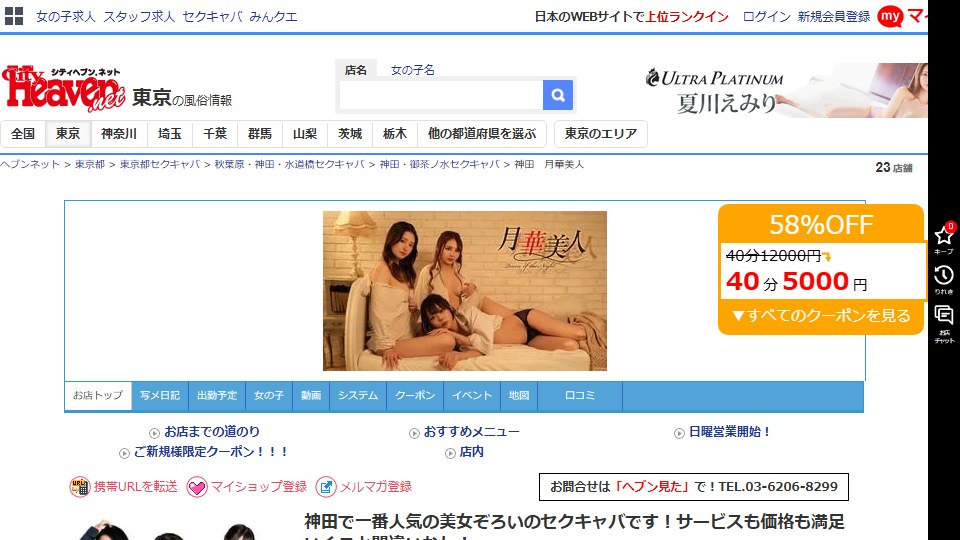
Kanda Gekka Bijin — 神田 月華美人, カンダゲッカビジン, Tel 03-6206-8299 — is on the fourth floor of the Watanabe Jūken Building at Uchi-Kanda 3-12-5, one minute from the station. Doors at 20:00, close listed as LAST. The genre tag on Cityheaven reads セクキャバ (スタンダード) — sekukyaba, standard tier.
Quick orientation for anyone reading this from outside Japan, because the word doesn't translate cleanly: a sekukyaba is a sexy cabaret. You sit at a table, you buy drinks, a woman sits with you, and the amount of contact permitted is considerably more than a hostess club and categorically less than anything with a bed in it. There is no room. There is no hotel. There is no "course" in the delivery-health sense. What there is, instead, is a bill — and at a sekukyaba the bill is the whole risk profile. Nobody gets ambushed by the service here. People get ambushed by the arithmetic.
So let's do the arithmetic.
The set board, and the meter under it
Three entry prices, all of them as displayed on the listing:
| Set | Price | Per minute |
|---|---|---|
| Free (40 min) | ¥12,000 | ¥300 |
| Honshimei — designated (40 min) | ¥16,000 | ¥400 |
| Dōhan 2SET (80 min) | ¥35,000 | ¥437.50 |
The base meter is ¥300 a minute, which is exactly the Tokyo standard — the same rate I've measured at delivery healths in Shibuya and esthe shops in Ikebukuro, arrived at independently by shops that share nothing but a city. Three hundred yen a minute is what a woman's time costs in this town. Everything above it is optional, and everything above it is where the shop actually makes its money.
Note the middle row. ¥16,000 minus ¥12,000 is ¥4,000, and ¥4,000 is precisely the honshimei (designation) fee listed further down the page. So the designated set isn't a different product with a different rate. It's the Free set with the fee stapled to it. Hold that thought, because it's the key to the whole board.
"Free" is a seating policy, not a discount
Here is the single most important line on the page, and it's buried under the fee table in small type rather than printed at the top where it belongs:
当店は基本的に1setにつき2~3人の女の子がかわるがわるお客様のお席にご一緒させていただきますが、店内にてお客様の希望により女の子をご指名頂く場合には1人毎に場内指名料が発生します。
As a rule, two to three women will rotate through your table over the course of one set; if you wish to designate a particular woman while in the shop, a jōnai designation fee is charged per woman.
Read that again with your wallet open. The ¥12,000 Free set does not buy you forty minutes with a woman. It buys you forty minutes at a table through which two or three women pass on the house's schedule, in the house's order, for however long the house feels like leaving each one there. You are not choosing. That's what "Free" means in this vocabulary — free of choice, not free of charge. It's the rotation model, it's standard for the genre, and it is not a scam. But an English-reading first-timer walks in expecting the woman in the photo he liked to sit down and stay, and that is not what ¥12,000 purchases.
The moment you want it to mean what you assumed it meant, the price is ¥4,000 per woman:
| Fee | Price |
|---|---|
| Jōnai shimei — choosing someone in the shop | ¥4,000 |
| Honshimei — designating in advance | ¥4,000 |
| VIP CHARGE (40 min) | ¥15,000 |
One thing here is genuinely fair and deserves saying: both designation fees are the same ¥4,000. Plenty of shops charge more for the in-house pick than the advance booking, or vice versa, to nudge you toward whichever one suits their staffing. Gekka Bijin charges a flat toll for the act of choosing regardless of when you choose. No penalty for making up your mind late, no discount for making it up early. That's a clean design.
What isn't clean is the multiplication. Pick one woman mid-set and your ¥12,000 becomes ¥16,000 — ¥400 a minute. Like two of the three who rotate through and want both to come back? That's ¥8,000 on top of ¥12,000: ¥20,000 for forty minutes, ¥500 a minute, and you have not ordered a drink yet.
The extension board confesses
Four numbers, and they're the most interesting thing on the site:
| Extension | Price | Per minute |
|---|---|---|
| Free — 20 min | ¥8,000 | ¥400 |
| Free — 40 min | ¥12,000 | ¥300 |
| Designated — 20 min | ¥12,000 (fee incl.) | ¥600 |
| Designated — 40 min | ¥16,000 (fee incl.) | ¥400 |
Two findings fall straight out of this table.
One: the nomination fee recurs. Subtract the Free row from the designated row at each length. Twenty minutes: ¥12,000 − ¥8,000 = ¥4,000. Forty minutes: ¥16,000 − ¥12,000 = ¥4,000. The shop even labels it — 指名料込み, designation fee included — on both designated extension prices. The fee isn't an entry toll you pay once at the door for the privilege of an evening with your pick. It is charged again on every block of time you buy.
Run that forward. You come in, designate, and stay two hours with the same woman:
| Block | Price | Of which is fee |
|---|---|---|
| Designated set, 40 min | ¥16,000 | ¥4,000 |
| Designated extension, 40 min | ¥16,000 | ¥4,000 |
| Designated extension, 40 min | ¥16,000 | ¥4,000 |
| 120 minutes, one woman | ¥48,000 | ¥12,000 |
A quarter of that bill is you paying, three separate times, to keep the woman who never left. The same two hours on the Free rotation costs ¥36,000. The loyalty premium at this shop is twelve thousand yen for a two-hour night, and it scales with every extra forty minutes you stay.
Two: never buy the twenty. Look at the per-minute column again. The 40-minute extension runs at the base ¥300 (Free) or ¥400 (designated) — the same rate as your opening set, which is a shop declining to punish you for staying, and I'll credit it. The 20-minute extension runs at ¥400 and ¥600. That's a 33% and a 50% markup for buying your time in halves.
Concretely: a designated 20-minute extension costs ¥12,000 — the exact price of an entire 40-minute Free set. Twenty minutes with your pick, or forty minutes with the rotation, for identical money. And two 20-minute designated extensions come to ¥24,000 where one 40-minute designated extension is ¥16,000. Eight thousand yen, evaporated, for the crime of deciding twice instead of once.
This is the trap, and it's a soft one — nobody's hiding it, the numbers are right there on the page. But it's set exactly where a person is least equipped to see it: forty minutes in, third drink, the woman you like is finally the one at the table, someone appears at your elbow and asks if you'd like a little more time. Twenty minutes sounds modest. Twenty minutes sounds like the responsible answer. Twenty minutes is the most expensive minute-for-minute product this shop sells.
Decide before you walk in. If you think you might stay past forty minutes, buy the forty.
The 58% coupon is real
I spend most of my life debunking Japanese discount badges. Ninety percent of them are a percentage calculated against a price nobody was going to pay, or a rebate that lands on a total the coupon itself excludes. So it's worth being loud when one is straightforward.
The coupon strip on Gekka Bijin's listing reads:
58%OFF — 40分 12,000円 → 40分 5,000円
Twelve thousand to five thousand is a ¥7,000 reduction, and ¥7,000 ÷ ¥12,000 is 58.3%. The badge is arithmetically correct. The struck-through price is the shop's actual published Free-set price, not an invented list price. And the resulting rate is ¥125 a minute — well under half the Tokyo baseline, and cheaper per minute than a lot of Ginza coffee.
The shop's recommended-menu banner flags a new-customer-only coupon (ご新規様限定クーポン), so read the coupon tab for the conditions before you count on it, and confirm on the phone — but the number itself is not doing anything sneaky, and that's rarer than it should be.
There's a second thing worth knowing: the topics section says the shop runs ゲリラ割 — "guerrilla discounts" — announced without warning, plus mail-magazine-only event pricing. If you're within walking distance of Kanda station on a regular basis, the newsletter is the cheapest thing on this page.
The Sunday contradiction, on one screen
The shop information block says:
定休日:日曜定休 — Closed Sundays.
The recommended-menu banner, a couple of hundred pixels above it on the same page, says:
日曜営業開始! — Sunday service begins!
Both of these are on the listing right now. One of them is stale, and I can't tell you which from the page alone — the banner reads like a newer announcement overriding an older policy, which is the most likely story, but "most likely" is not something to build a Sunday evening on. Kanda on a Sunday is a ghost town; the offices are dark, half the izakaya are shuttered, and there is nothing to fall back on if you climb to the fourth floor and find a locked door.
Call 03-6206-8299 before any Sunday visit. For that matter, call before any visit — the closing time is published as "LAST," which is not a time.
VIP charge: ¥15,000 for a thing the page never describes
Sitting in the fee table between the drinks and the designations:
VIP CHARGE (40分) — 15,000
Fifteen thousand yen for forty minutes is ¥375 a minute, layered on top of the ¥300 you're already paying, for a combined ¥675 a minute — and the page does not say what it is. Not a room description, not a minimum, not a bottle requirement, not a photograph. A private room is the obvious guess and probably the right one, but a ¥15,000 line item that costs more than the set it attaches to has earned a sentence of explanation, and it doesn't get one.
If you want it, get the terms on the phone. Don't discover them on the bill.
The ceiling, and how far it is from the floor
The drinks board:
| Drink | Price |
|---|---|
| SINGLE | ¥2,500 |
| DOUBLE | ¥3,500 |
| SHOT | ¥4,000 |
| Tequila ferris wheel | ¥50,000 |
| CHAMPAGNE | ¥70,000~ |
Nothing here is cheap, and the singles matter more than the champagne because the singles are what you'll actually order. A ¥12,000 Free set plus two singles is ¥17,000 — an effective ¥425 a minute for a forty-minute sit. The drink menu quietly moves the real rate 40% above the headline before anyone has designated anybody.
Then there's the top of the board, and it's worth translating into the only currency this page has established. At the base ¥300-a-minute rate, the ¥50,000 tequila ferris wheel is 166 minutes of table time — nearly three hours. The ¥70,000 champagne is 233 minutes, close to four. Both of those are things a person can order in a room they entered on a ¥5,000 coupon. That's a fourteen-fold spread between the front door and the ceiling, in the same forty minutes, and every sekukyaba in Japan is built on the gap between the two. Knowing where you intend to sit on that spectrum before you sit down is 90% of enjoying the evening.
The invoice registration is a tell
Tucked at the top of the topics section, in brackets, easy to scroll past:
【インボイス登録店】
This means the shop is a registered issuer under Japan's qualified-invoice system — it can hand you a compliant receipt that a company can actually process for tax purposes. Most people reading this in English will skim past it. Don't. It tells you exactly who this shop thinks its customer is.
Kanda is a business district. The men coming up those stairs at 20:15 are here from an office they left twenty minutes ago, some of them with a client in tow, and an invoice-registered sekukyaba is a shop saying: we can paper this. That single bracketed line explains the ¥35,000 dōhan set, the ¥70,000 champagne, and the ¥15,000 VIP charge more completely than any of the marketing copy does. It is not really priced for you. It's priced for an entertainment budget.
Which, honestly, is good news for a walk-in. Everything cheap on this board — the coupon, the Free rotation, the 40-minute extension at flat rate — is priced for the man paying with his own money, and it's priced fairly. Everything expensive is priced for the man who isn't.
Dōhan, and what the ¥3,000 buys
The dōhan (accompanied-arrival) product is 80 minutes for ¥35,000. Compare it to buying the same 80 minutes designated in-shop: ¥16,000 for the set plus ¥16,000 for a 40-minute designated extension is ¥32,000. So the dōhan premium is ¥3,000.
That's cheap for the genre, and cheap for what it is — dōhan means she meets you outside, you have dinner, you arrive together — but the listing states no conditions at all: no arrival deadline, no minimum notice, no rule about which women accept it. Those conditions always exist. They're just not here. And the dinner is yours to pay for on top, which no line on this page mentions either.
What the roster page actually shows
The manager's picks are listed as Kanae, Uno, Noa, Rion, Ito, Madoka, Mei, and Nana, with a link out to the full cast list. The concept copy sells range:
素人系からキレイ系、ギャル系、清楚系、ロリータ系まで
From amateur types to beauties, gyaru, demure types, and lolita types — the standard four-quadrant sweep that means "we have a variety," which every shop in Japan claims and which is not information.
The photo diary is more useful, and thinner than it looks. Seven posts on the front page spanning 22 July to 20 August — call it one post every four days across the entire roster — and three of the seven are by the same woman, Kanae, one of them captioned 復帰 (returning). The most recent entries are Noa on 8/20 at 23:58 and Kanae on 8/20 at 21:23, so the diary is live, not abandoned. But if your plan is to read the diaries and pick someone whose personality you've gotten a feel for, there is close to nothing here to read. At this shop, the rotation is the discovery mechanism. That's arguably the point of the format — but it means the ¥4,000 you pay to choose is ¥4,000 you're spending on forty minutes of impression rather than any real prior information.
Two more things about the page itself
The official website field points at the page you're already on. Under オフィシャルサイト(PC), the listing gives https://www.cityheaven.net/tokyo/A1310/A131002/kannda_raclee/ — its own Cityheaven URL. There is no independent site. That's not unusual, but it raises the stakes on everything above: this listing isn't a summary of the shop's information, it is the shop's information. The Sunday contradiction and the undefined VIP charge have nowhere else to be resolved. Only the phone.
And the URL still says raclee. The permalink carries a name that isn't on the sign — a previous shop, or a previous branding, fossilized in a path Cityheaven won't rewrite. Meanwhile the concept copy is still announcing a グランドオープン, a grand opening, on a listing whose cast diaries run back through the summer. Neither of these costs you a yen. They're just the tell that nobody has done a full pass over this page in a while, which is the same reason there are two different answers about Sunday sitting four inches apart.
Rules, and the language situation
The listing carries the standard statutory notices: no one under 18 (including high-school students) may use the shop, and no companion under 18 is employed there. Both are non-negotiable and both are enforced at the door.
There is no English anywhere — not on the listing, not in the fee table, not in the small print that explains the rotation. The one instruction the page does give is the universal Japanese nightlife password: when you call, say 「ヘブン見た」 (Heaven mita — "I saw you on Heaven"), which the shop asks for explicitly and which, at most shops, is what makes the listed pricing apply.
A sekukyaba is also, of all the genres, the one where language matters most and people assume it matters least. There's no room and no menu of acts — the entire product is conversation at a table, in Japanese, with a woman who is being rotated in and out on a timer. If you can't hold a light conversation in Japanese, you are buying forty minutes of two strangers being professionally gracious about a silence. Some people are fine with that. Know which person you are before you spend ¥12,000 finding out.
About the shop
| Name | 神田 月華美人 (Kanda Gekka Bijin) |
| Genre | Sekukyaba — sexy cabaret (standard) |
| Area | Kanda / Ochanomizu |
| Address | Uchi-Kanda 3-12-5, Watanabe Jūken Bldg 4F, Chiyoda-ku, Tokyo |
| Access | 1 min walk from Kanda Station |
| Hours | 20:00 – LAST |
| Closed | Sundays (but see the Sunday contradiction above — call) |
| Tel | 03-6206-8299 |
The verdict
| 58% coupon that is arithmetically honest — ¥12,000 → ¥5,000 | ★★★★★ |
| 40-minute extensions priced at the same rate as the opening set | ★★★★☆ |
| Jōnai and honshimei fees identical at ¥4,000 — no penalty for deciding late | ★★★★☆ |
| Base rate at the ¥300/min Tokyo standard | ★★★★☆ |
| The rotation rule actually stated in writing, if not prominently | ★★★★☆ |
| One minute from a JR station, in a district with somewhere to go after | ★★★★☆ |
| Dōhan premium of only ¥3,000 over the equivalent in-shop time | ★★★☆☆ |
| Photo diary alive but thin — 7 posts in a month, across the whole roster | ★★★☆☆ |
| Nomination fee recharged on every extension block, never stated as such | ★★☆☆☆ |
| 20-minute extensions at ¥400–¥600/min, sold at the weakest moment | ★★☆☆☆ |
| ¥15,000 VIP charge with no description of what it is | ★★☆☆☆ |
| Two contradictory answers about Sunday on the same screen | ★★☆☆☆ |
| Closing time published as "LAST" | ★★☆☆☆ |
| Dōhan conditions and deadlines stated nowhere | ★★☆☆☆ |
| Accessibility for non-Japanese customers | ★☆☆☆☆ |
| Overall | ★★★☆☆ |
Three stars, and I want to be precise about what the three stars are measuring, because this shop's failures and its virtues are not the usual ones.
Gekka Bijin does not hide fees. Everything I've unpacked above — the recurring designation charge, the punitive 20-minute block, the ¥675-a-minute VIP ceiling — is derived entirely from numbers the shop published on its own page, in a table, in public. Nothing was buried in a coupon's fine print or dug out of somebody's blog. The shop's sin isn't concealment. It's that it prints the ledger and leaves you to audit it, at eight in the evening, on a fourth floor, with a drink in your hand.
So audit it before you climb the stairs. Take the coupon — it's real, it's 58%, and ¥125 a minute is the cheapest legitimate entry price I've written up in months. Understand that Free means rotation, and that two or three women passing through your table is the product, not a staffing accident. If you're going to designate, designate once and buy time in forty-minute blocks, because the fee lands again on every block and the twenty-minute block is a 50% markup wearing a modest number. Get the VIP charge explained on the phone rather than on the receipt. And call before Sunday, because the page will tell you two different things and only one of them will be standing behind the door.
Do that, and this is a fair-priced sexy cabaret one minute from a JR station in a neighborhood that empties out politely at eleven. Don't, and it's a ¥48,000 evening you meant to be a ¥17,000 one — and every yen of the difference will have been printed on the page you didn't read.