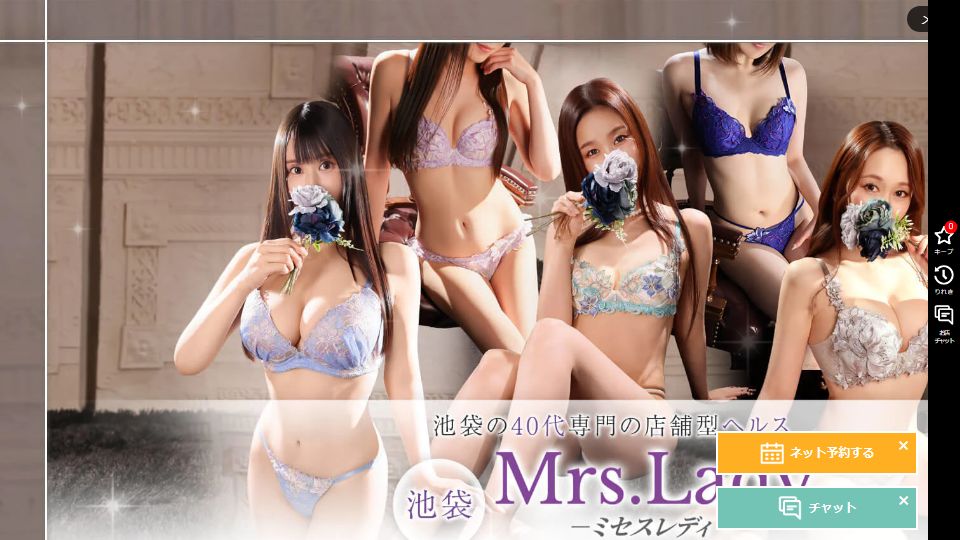

Let me tell you what a 店舗型ヘルス — a store-type health house, what the trade calls a hakoheru, a "box health" — actually is, because the name Mrs. Lady and the polite marketing will not. It is not delivery. Nobody comes to your hotel. There is no hotel in the equation, and that's the entire point. You walk to a specific building on the West/North side of Ikebukuro, in Toshima Ward, three minutes on foot from the station, and everything happens inside that building. No love-hotel receipt, no cab, no fifteen-minute dead zone waiting for dispatch to text you a room number. The shop is the room. That structural fact is the first thing worth understanding, because it changes the math of the whole visit before a single woman walks in.
The Model: Own the Building, Kill the Hotel Fee
Most of the coverage of Tokyo's mature-woman scene is about delivery — deriheru, the woman dispatched to a rented room. Mrs. Lady runs the older, quieter model, and the older model has one clean advantage: no hotel fee. In deriheru you pay the course price and the love hotel on top, and that second bill is real money — three, four thousand yen minimum, more at night. The store-type house folds the space into the price. The number on the board is closer to the number you actually spend. For a shop parked in Ikebukuro — where the love hotels are neither cheap nor scarce — that's not a rounding error. It's a genuine structural discount for the customer who does the arithmetic, and it's why the box-health format never fully died even as delivery ate the map around it.
The 6 A.M. Door
Here's the number that made me stop and read the shop twice: it opens at 6:00 in the morning and runs to midnight, every day of the year. Six a.m. is not a casual detail. A place that unlocks the door at dawn is telling you exactly who it's built for — the man coming off a night shift, the salaryman with an early train and an hour to kill, the guy whose schedule doesn't fit the industry's default 10-a.m.-to-late window. Most shops in this genre don't bother; the morning is dead air. Mrs. Lady treats the morning as a market segment nobody else is serving, which is the single smartest thing a commodity business can do — find the hours the competition ignores and own them uncontested. An 18-hour door is a shop working the shifts, not just the peaks.
The 40s Bet
Mrs. Lady is 人妻専門 — married-woman specialist — and it plants its flag specifically on the 40s: "40代の大人の美熟女," beautiful mature women in their forties. Read that as a positioning decision, not a limitation. The reflexive assumption is that "older cast" means "settled for what they could recruit." Wrong read. Age-forty-plus is a deliberately chosen niche in this market, and it's a defensible one, because the twenty-something roster is where every shop in Tokyo is knife-fighting for the same faces. By declaring the 40s its specialty, Mrs. Lady stops competing in the most crowded segment of the market and claims a lane where the demand is real, loyal, and dramatically underserved. The men who want the jukujo — the mature woman, the composure and the unhurried warmth that a nervous twenty-two-year-old simply cannot fake — know exactly how few doors are actually built for them. This is one. That's not a compromise roster. It's a targeted one.
The Group Behind It, and the Board
Two more facts worth reading straight. Mrs. Lady is an Alice Group franchise (アリスグループFC加盟店) — meaning it isn't a lone storefront improvising the playbook; it's running on an established operator's system, which usually translates to cleaner phone handling and fewer nasty surprises at the register. And the pricing, as far as I could pull it honestly off the page: new customers get 30 / 45 / 60-minute courses, with the 30-minute entry shown around ¥10,000 — roughly ¥9,000 with a 10%-off coupon. I won't invent the mid and upper tiers I couldn't verify, but the entry point reads as a true mid-market floor for central Tokyo, and remember to fold in the no-hotel-fee advantage when you compare it against any deriheru rate. Store address is Nishi-Ikebukuro 1-34-6, and there's no street solicitation — you go to the shop, plainly, like an adult.
The Verdict on the Door
- Format sense: ★★★★☆ — store-type means no hotel bill and no dispatch dead zone; the shop is the room, three minutes from the station.
- Access to the right buyer: ★★★★☆ — a genuine 40s-jukujo specialist in a market where that lane is criminally underserved.
- Hours: ★★★★★ — a 6 a.m. door running to midnight, 365 days; it serves the shifts nobody else will touch.
- Price honesty: ★★★★☆ — ~¥9,000–¥10,000 entry with a coupon, and the folded-in room cost makes the real spend cleaner than the deriheru comparison suggests.
- Going back: ○ — if the jukujo fantasy and a walk-in-at-dawn schedule are what you want, there are very few doors this precisely aimed at you.
I came at Mrs. Lady expecting the store-type model to feel like a relic — the format delivery was supposed to have buried. It doesn't. It reads like a shop that looked at the crowded, hotel-taxed, evening-only default everyone else runs and quietly declined all three constraints: it owns its building, it opens at dawn, and it points its whole roster at the one age bracket the rest of the market keeps overlooking. That's not the door for the man chasing the impossible nineteen-year-old down the street — that man has a hundred other doors. It's the door for the one who's done paying a love hotel for the privilege, done working around a schedule built for someone else's day, and old enough to know that composure is worth more than youth. Walked in off the West Exit, no hotel receipt in my pocket, and the math — for once — was on my side.