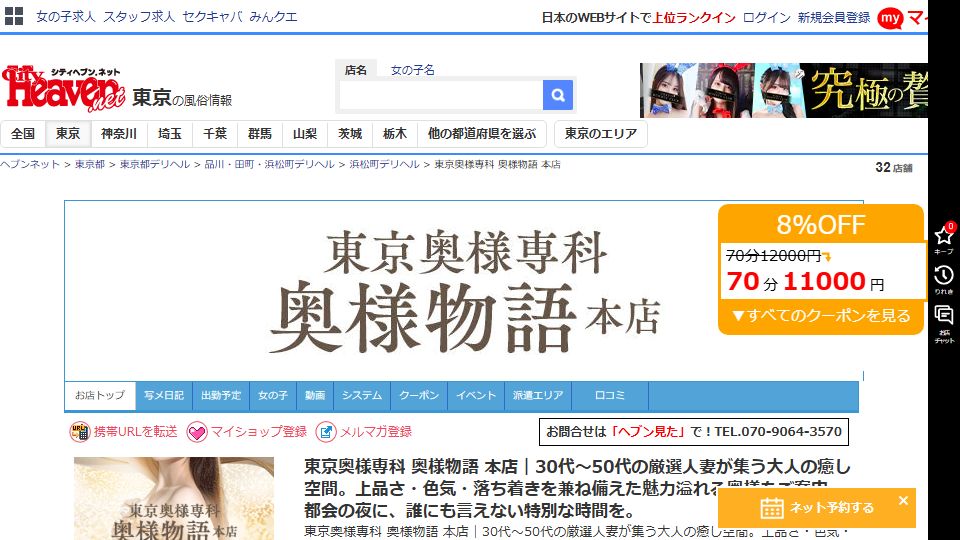

Everybody who writes up a hitozuma — married-woman — shop leads with the same word: "mature." As if age were the product. It isn't. I fetched the page for Okusama Monogatari in Hamamatsucho expecting the usual thirty-to-fifties roster copy, and the word that actually stuck wasn't on the girl page at all. It was in the concept blurb: 落ち着き — composure. Not "mature," not "experienced." Composed. And once you notice a shop is selling composure instead of youth, everything else on the listing — the neighborhood, the hours, the price ladder — starts to line up behind that one idea.
The Neighborhood Is the Whole Argument
Look at where this thing lives. Hamamatsucho isn't a nightlife town. It's a transit organ — the monorail to Haneda runs out of it, the business hotels stack up around the station, the sidewalks fill at 8 AM with suitcases and empty out by nine at night. It is, structurally, a place built for people who are between two other places. Nobody's from Hamamatsucho. Everybody's passing through it.
That is a strange home for a nightlife business and a perfect one for this particular shop. A married-woman delivery service isn't chasing the drunk-at-midnight crowd; it's chasing the man in the business hotel who's got an evening he didn't plan for, a per-diem, and nobody expecting him until the morning flight. The elegance angle isn't decoration out here — it's the exact product a traveler in a good hotel is primed to want. He doesn't want a party. He wants an adult evening that feels like it belongs to a grown-up's life, in a room he's renting anyway. The shop read its town correctly: it planted a composure business in the one district where half the customers are already sitting still, waiting for the day to end.
The Price Ladder Is a Bet on the Long Course
Here's where it gets sharp. Most delivery shops build their menu to sell you the short course — the 60- or 70-minute quickie is the loss leader, the thing that gets you in the door. Okusama Monogatari lists a 70-minute at ¥12,000 (¥11,000 with the coupon on the page), and then it keeps climbing: 90 for ¥17,000, 110 for ¥22,000, 130 for ¥27,000, 150 for ¥32,000, and a 180-minute course sitting at the top for ¥42,000.
Run the arithmetic and the shape tells you what they actually sell. The short course is the most expensive per minute; every rung up the ladder gets cheaper by the minute. That's not an accident, and it's not generosity — it's a shop telling you, in the only honest language a business has, that the product isn't the sixty-minute transaction. It's the evening. A composure-based, married-woman product doesn't shine in a rushed hour; it needs room to breathe — conversation, a drink, the unhurried arrival I keep coming back to. The menu is quietly steering the customer toward the thing the shop is actually good at, and pricing the three-hour course like it wants you to book it. On this listing, the smart money isn't the ¥11,000 taster. It's the man who reads the ladder and buys the time.
What "Married Woman" Actually Signals Here
Let me be precise, because the genre invites nonsense. The 30-to-50s framing isn't a fetish gimmick on this listing — it's the delivery mechanism for the composure I keep naming. The pitch is a woman who's past the stage of needing to prove anything, who runs the room without effort, who treats the hour as an adult meeting two adults rather than a performance staged for a customer. Whether any individual cast member lives up to that is between the man and the doorbell — I didn't sit through a session and I won't invent one. But the positioning is coherent, which is more than most shops in this genre can claim. They picked a neighborhood full of stationary grown-ups, a menu that rewards taking your time, and a roster premise built on the one quality that only comes with a few decades of being alive. Three decisions, one idea. That's a shop that knows what it is.
The Hours Quietly Confirm It
One more line that fits the pattern: the phones run 10:00 AM to 5:00 AM. Nearly around the clock, and — the part that matters — it opens in the morning, not the evening. A pure nightlife shop doesn't bother with a 10 AM open. A shop serving business hotels and irregular traveler schedules does, because its customer's clock isn't the city's clock. The man off a red-eye, the salaryman with a free afternoon before the return leg, the guest who checks in early — the near-24-hour window is the same "we serve people between places" thesis stated in operating hours. Everything on this listing rhymes.
The Read
Okusama Monogatari is a married-woman delivery shop that made an unusually consistent set of choices: a transit district full of stationary grown-ups, a price ladder that pays you to stay, a roster premise built on composure rather than youth, and hours that follow the traveler's clock instead of the party's. I came in braced for the usual "mature ladies" boilerplate and left thinking this is one of the more self-aware listings I've read in the genre. It knows its customer is a man who's briefly between the rest of his life, and it's built to give him an unhurried adult evening rather than a fast one.
Verdict: The Shop That Wants You to Stay
- Concept coherence: ★★★★★ — neighborhood, menu, roster premise, and hours all point at the same idea. Rare discipline for the genre.
- Location logic: ★★★★★ — a composure business in a business-hotel transit town is a shop that mapped its real customer, not the fantasy one.
- Price ladder: ★★★★☆ — ¥11,000 taster up front, but the per-minute math clearly rewards the long course; read the ladder before you book.
- Price honesty: ★★★★☆ — I quote the six course prices and the one coupon the page publishes, and nothing I didn't see listed.
- Going back: ◎ — for the traveler with an evening to spend and the sense to book the time, not the minute.
The useful takeaway isn't the age on the roster — it's the shape of the menu. Okusama Monogatari prices the long course like it wants you to take it, in a town full of men who've got nowhere to be until morning. Composure isn't cheap, and this shop is one of the few honest enough to sell it by the hour and mean it.