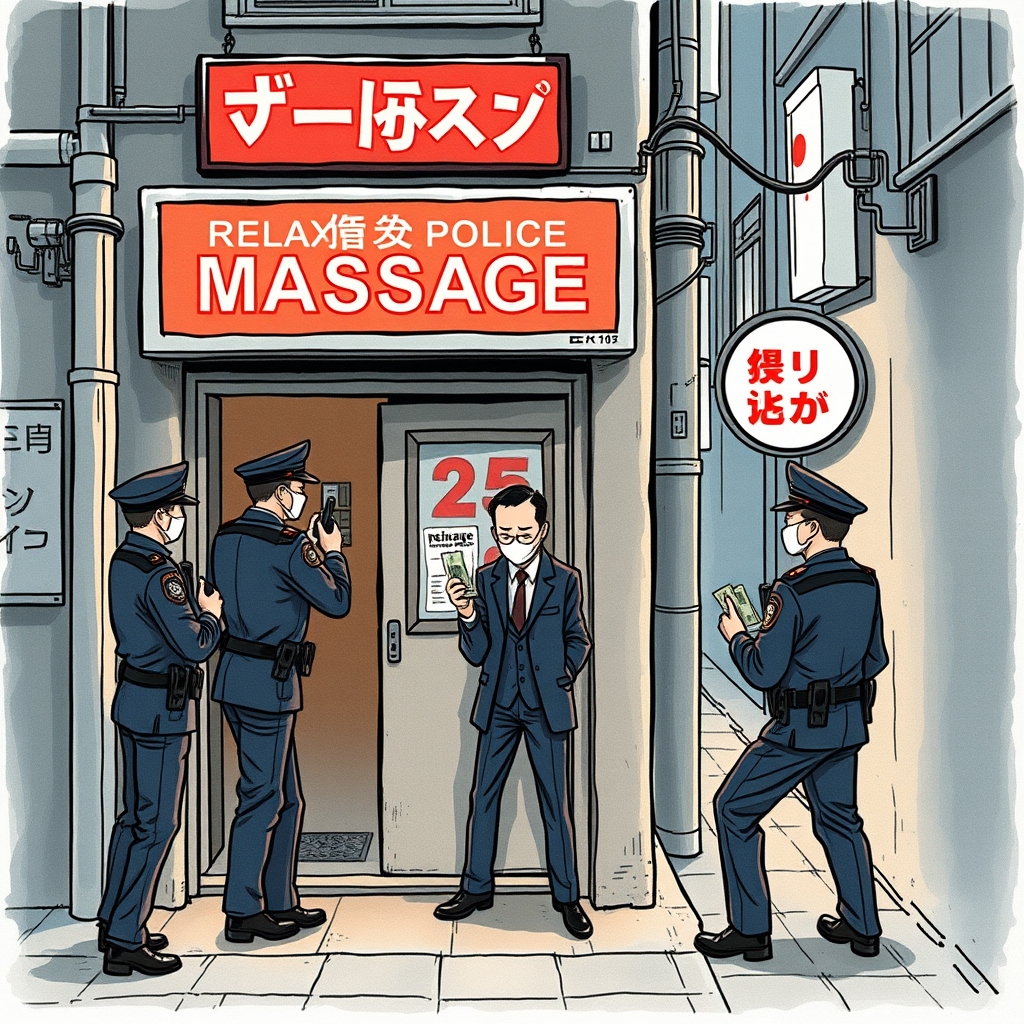
Operator of the Asakusabashi Shop Arrested
By June 8, 2026, the Kuramae Police Station of the Metropolitan Police Department arrested Kenichi Wakino (50), the operator of the private-room massage shop "Relaxation AINSEL," on suspicion of violating the Businesses Affecting Public Morals Regulation Act (operating in a prohibited area), for illegally running the business in an area where the operation of storefront-type adult-entertainment establishments is prohibited. The Sankei Shimbun and other outlets reported the case.
The alleged offense was that, on May 19, 2026, in a private room of a building near JR Asakusabashi Station—an area where storefront-type adult-entertainment businesses are not permitted—he ran a business having a female employee provide sexual services to a male customer. Wakino is said to admit the allegation.
Two female employees of Thai nationality, in their 30s and 40s, worked at the shop, which is said to have taken in about 1.24 million yen over roughly three weeks from May 1 to 19, 2026. The shop is believed to have operated since around 2018 (Heisei 30), and the investigation is ongoing.
Key Points of the Asakusabashi Case
- Who made the arrest: the Kuramae Police Station of the Metropolitan Police Department
- Suspect: Kenichi Wakino (50), operator of a private-room massage shop
- Shop name: "Relaxation AINSEL"
- Allegation: violation of the Businesses Affecting Public Morals Regulation Act (operating in a prohibited area)
- Date of the alleged offense: May 19, 2026
- Employees: two women of Thai nationality (in their 30s and 40s)
- Revenue: about 1.24 million yen from May 1 to 19
- Start of operation: around 2018
- Plea: admits the allegation
Four Also Arrested in Higashi-Gotanda, Shinagawa Ward
Earlier, by June 4, 2026, the Osaki Police Station of the Metropolitan Police Department had arrested four people, including the operator of the private-room massage shop "Bishou Bijo," on suspicion of violating the Businesses Affecting Public Morals Regulation Act, for likewise operating illegally in an area where storefront-type adult-entertainment businesses are prohibited, in Higashi-Gotanda, Shinagawa Ward. TBS NEWS DIG, the TV Asahi network (ANN), and other outlets reported the case.
According to the reports, those arrested were the operator, Kozo Miyazaki (58), and the manager, Yoji Sagawa (66), among others. The shop is said to have continued operating without putting up a sign, moving from place to place, and its revenue since around July of the year before last (2024) is believed to total about 180 million yen. In questioning, Miyazaki is said to deny the allegation, while Sagawa is said to admit it.
Key Points of the Shinagawa Case
- Who made the arrest: the Osaki Police Station of the Metropolitan Police Department
- Suspects: operator Kozo Miyazaki (58), manager Yoji Sagawa (66), and others, four in all
- Shop name: "Bishou Bijo"
- Allegation: violation of the Businesses Affecting Public Morals Regulation Act (suspected operating in a prohibited area)
- Manner of operation: operated without a sign, moving from place to place
- Revenue: about 180 million yen since around July 2024
- Plea: Miyazaki denies; Sagawa admits
A Common Method: Disguise as "Private-Room Massage"
What the two cases have in common is that, while outwardly billing themselves as "private-room massage" or "relaxation," in reality they provided sexual services. Storefront-type adult-entertainment establishments are strictly limited as to the areas in which they may operate, under the Businesses Affecting Public Morals Regulation Act and each prefecture's ordinances, and operating in a "prohibited area," such as near a school or in a residential district, is illegal regardless of whether a license is held.
Shops that try to slip through the regulatory net by taking the guise of a massage parlor or esthetic salon are endless, and there are conspicuous cases of trying to evade crackdowns through methods such as putting up no sign, making customers members-only, and frequently relocating. Both of these cases can be said to be ones in which police moved in on such "disguised" operations.
Foreign Employees and the Reality of Enforcement
In the Asakusabashi case, the fact that the employees were all of Thai nationality was also reported. In the adult-entertainment industry, there are cases in which foreign women in weak positions in terms of residence status or working conditions become the workforce, and when a crackdown occurs, attention turns not only to the responsibility of the operating side but also to the situation in which the employees are placed. On the other hand, in both of these cases, what has been reported so far is the building of cases against the operating and managing side; no cases against customers have been reported.
Background: The Revised Businesses Affecting Public Morals Regulation Act and Pressure on Storefront Adult Entertainment
This string of crackdowns is situated within the broader trend of tighter regulation surrounding the adult-entertainment industry.
What is the regulation on operating in prohibited areas?
The Businesses Affecting Public Morals Regulation Act prohibits storefront-type adult-entertainment special businesses from operating in areas designated by cabinet order or prefectural ordinance. Such areas include the surroundings of residential districts, schools, and hospitals, and operating a shop in these "prohibited areas" is itself subject to punishment. Because it is illegal regardless of whether a license is held, it is often used as grounds for cracking down on shops that operate covertly without notification.
The trend toward stronger penalties
The revised Businesses Affecting Public Morals Regulation Act, which took effect on June 28, 2025, sharply raised the penalties for unlicensed operation and operation in prohibited areas, alongside measures against malicious host clubs and a ban on scout-backs. The penalty for an individual was strengthened from "imprisonment of up to two years or a fine of up to 2 million yen" to "imprisonment of up to five years or a fine of up to 10 million yen," and the judicial and administrative stance toward illegal storefront operations is growing stricter. Which penalty provision applies to each case differs depending on the timing of the alleged conduct, and the final disposition awaits the future course of the investigation and judicial judgment.
A structure of continuing enforcement
Crackdowns on illegal operations under the guise of "private-room massage" have continued in various places in recent years, and cases of busting shops with annual revenue exceeding 100 million yen are not uncommon. As long as there is demand, new shops are born and police chase them—the two cases in Asakusabashi and Shinagawa also reflect the current state of this "cat-and-mouse game."
This article is compiled from reporting by the Sankei Shimbun of June 8, 2026, and TBS NEWS DIG and the TV Asahi network (ANN) of June 4, 2026, among others. Specific persons, amounts, place names, and the like are based on the reporting, and all allegations are at the investigation stage.