From a Shuttered Club to a Syndicate's Books
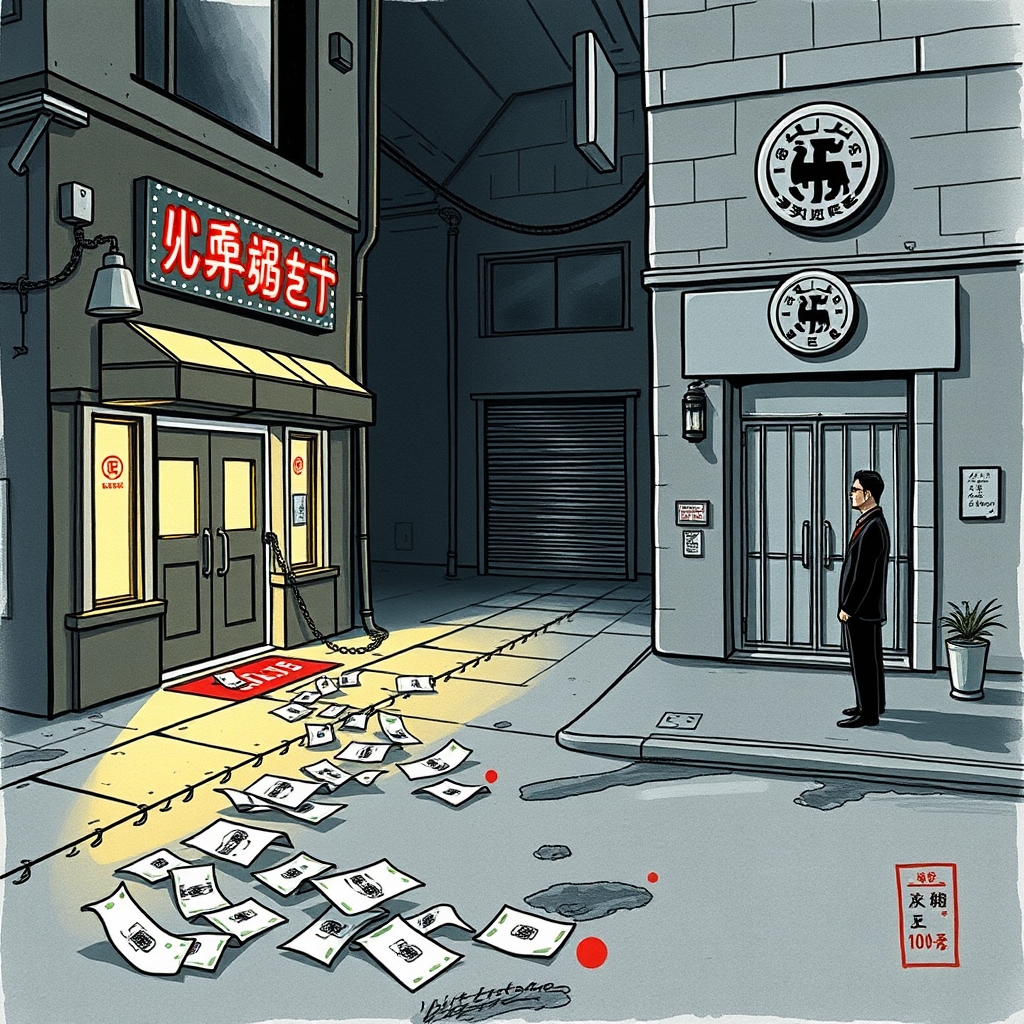
The case did not start at the gang office. It started at a cabaret club in Kurume, Fukuoka Prefecture—a business that police say was seating customers with female staff and charging for their company without ever holding the license the law requires. In June 2026, investigators shut it down and arrested its operator. What they wanted to know next was where the money went.
On July 9, 2026, the Fukuoka Prefectural Police arrested a 30-year-old man they identify as a member of an organization under Dojin-kai (道仁会), one of Japan's designated organized-crime groups (boryokudan), on suspicion of violating the Act on Punishment of Organized Crimes (soshikiteki hanzai shobatsu-ho)—specifically its ban on knowingly receiving criminal proceeds. The following morning, July 10, roughly a dozen investigators entered an affiliated group's office in Kurume and carried out a search. The arrests and search were reported by the Asahi Shimbun and by four regional broadcasters—Kyushu Asahi Broadcasting (KBC), Television Nishinippon (TNC), Fukuoka Broadcasting System (FBS) and TVQ Kyushu Broadcasting—among others.
The reported details are allegations at the investigative stage. No indictment or finding of guilt has been established, and the suspect denies the charge.
What Investigators Allege
According to the reporting, the man—named in some accounts by the surname Nakamura, with the reading of his given name uncertain in English—is accused of receiving about 300,000 yen roughly two years ago while knowing the cash was revenue from the unlicensed Kurume cabaret. That single sum is the charge on paper. The larger question police are pursuing is whether the club's earnings were feeding the crime group, becoming, in the authorities' words, part of its operating funds.
The July 10 search fits that theory rather than the individual charge. Investigators did not simply detain a man and close the file; they moved the following day against the physical premises of the affiliated organization—reported to be a subordinate group of Dojin-kai based in Kurume—an approach aimed at documenting the flow of money from the shopfront to the syndicate. Police have said the suspect denies the allegation.
The Law Being Used
The choice of statute matters. Police did not charge this case under the Businesses Affecting Public Morals Regulation Act (fuei-ho, the law that licenses and zones nightlife and adult-entertainment businesses). That law was the instrument used against the cabaret itself in June, for operating "entertainment food and drink" service—seating guests with hostesses—without a permit.
The follow-on case reaches instead for the Organized Crime Punishment Act, which criminalizes the receipt and concealment of criminal proceeds. Used this way, the law is a pipe-tracing tool: it lets investigators treat the cash generated by an illegal business as tainted at the moment it changes hands, so that a person who merely accepts the money—without running the club, seating a customer, or pouring a drink—can be the defendant. The target is not the night's transactions but the destination of the night's cash.
That framing has become a recurring feature of how Japanese police approach the intersection of nightlife and organized crime. Rather than settling for a licensing charge against a replaceable operator, investigators try to establish that the proceeds climbed the chain into a designated syndicate—because it is the flow of money, not the individual storefront, that sustains the group.
Dojin-kai, in Context
Dojin-kai is not a marginal outfit. Headquartered in Kurume, it is, by the prefectural police's count, the largest of the five designated organized-crime groups in Fukuoka, with roughly 300 members as of the end of 2025. Fukuoka has long been among the most heavily policed prefectures for boryokudan activity, and cutting off the revenue that flows to such groups from bars, clubs and the wider night-time economy is a stated priority of local enforcement.
An unlicensed cabaret is, in that light, more than a licensing infraction. If the authorities' account holds, it is a small revenue node—one shuttered club—whose cash the police say they can now trace into the accounts of a syndicate. The 300,000 yen named in the charge is modest; the point of naming it is what it is alleged to connect.
What Remains Unproven
The record so far is narrow and one-sided. One man has been arrested on a single count covering a single sum from about two years ago, and he denies it. The office search is an investigative step, not a verdict; it produces evidence to be weighed, not a finding. The broader claim—that the club's earnings were funding Dojin-kai—is the police's working theory, not an established fact.
What the week shows is the direction of the investigation: from a licensing crackdown on an illegal nightlife business in June, to a proceeds-tracing arrest in July, to the door of an affiliated crime-group office the next morning. Whether that line holds all the way up the chain will be settled in the ordinary course of the investigation and any prosecution that follows. As with any arrest, the suspect has not been convicted, and the account to date is the authorities'.
This article is compiled from July 9–10, 2026 reporting by the Asahi Shimbun, Kyushu Asahi Broadcasting (KBC), Television Nishinippon (TNC), Fukuoka Broadcasting System (FBS) and TVQ Kyushu Broadcasting, carried in part via Yahoo! News Japan. Facts are attributed to those reports and to the police. The suspect's name reading is uncertain in English and is given as reported; the syndicate's size and the money figures are the authorities' account. The allegation is unproven, and points that remain unconfirmed are noted as such.