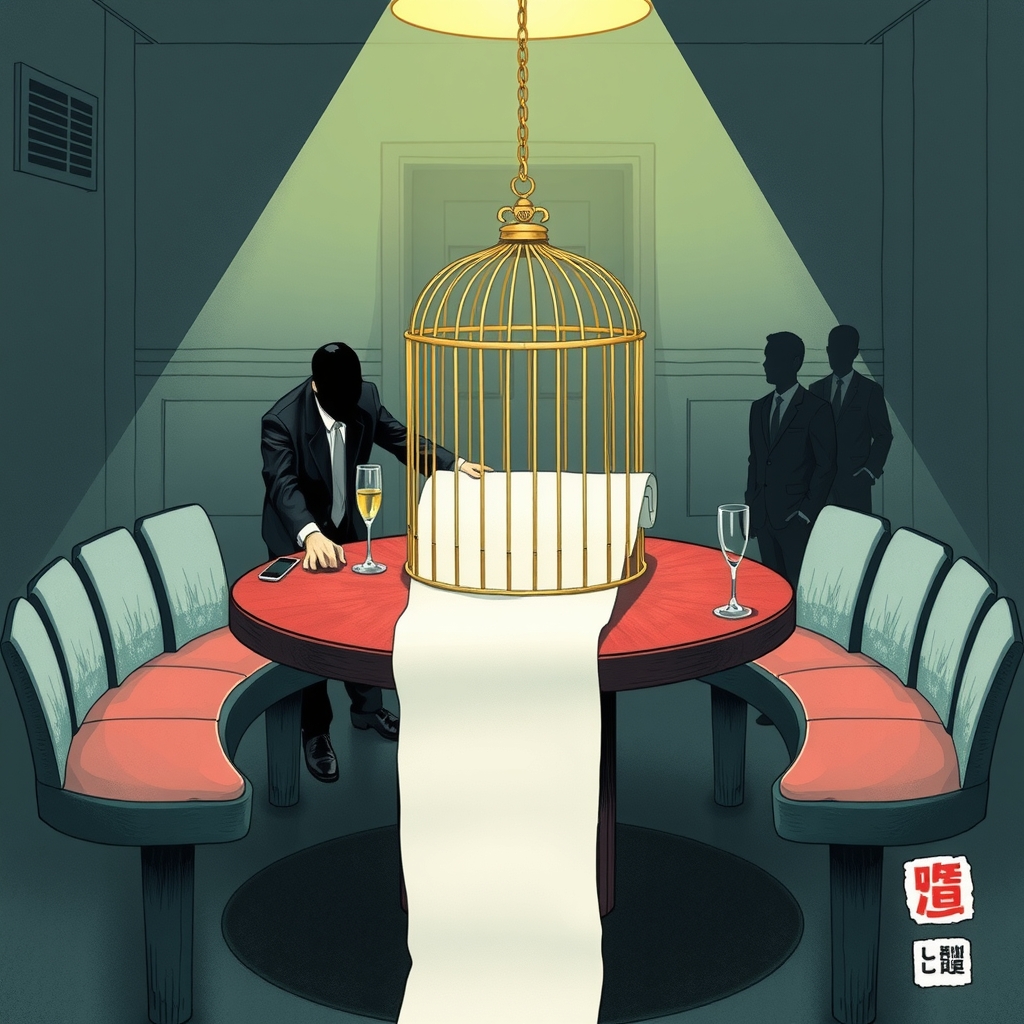
Write Down Your Parent's Number
The instruction police described was not a threat. It was a dictation.
Write that you will pay the remaining ¥381,000 today. Write the name of your company. Write your parent's phone number.
On August 20, 2026, Aichi prefectural police announced the arrest of two men over what happened next in a hostess club in central Nagoya: the customer's driver's license, according to police, was taken from him.
Arrested on suspicion of violating Aichi Prefecture's anti-fleecing ordinance — the bottakuri boshi jorei, formally the Ordinance on the Regulation of Improper Solicitation and Improper Collection of Charges in Businesses Serving Alcohol — were Fukuda Kodai, 28, identified in reporting as the owner and company president of the kyabakura hostess club DEAREST CLUB in Nishiki 3-chome, Naka Ward, and Obana Toshimaru, 25, an employee of the same club.
Police have not disclosed whether either man admits or denies the allegation.
What Police Allege
According to accounts broadcast by CBC Television, Tokai Television and Mētele (Nagoya TV), the conduct dates to July 25, 2026, inside the club.
A male customer in his twenties was billed roughly ¥530,000 for a single visit. When he could not settle it, the two men are alleged to have pressed him to write out a statement acknowledging a ¥381,000 balance due that same day, along with his employer's name and a parent's telephone number — and to have taken his driver's license in the course of collecting.
That last detail is not incidental color. It is close to the statutory language.
Article 6 of the ordinance prohibits any person from collecting charges or penalty payments from a customer of an alcohol-serving business "using crude or violent words or conduct, or by methods that cause the customer distress, such as concealing possessions taken from that person." The ordinance does not require that a threat be made, or that the bill itself be proven fraudulent. The method of collection is the offense.
Eleven Complaints Since January
Police told the broadcasters that billing disputes involving this one establishment have generated 11 complaints since January 2026, with total losses across those cases estimated at roughly ¥5.6 million.
Eleven complaints in seven months is a pattern that police were tracking well before the July 25 incident, and it is worth being precise about what that number represents. It is not the number of customers overcharged. It is the number who went to the police afterward — a category that systematically excludes the person who was too embarrassed to file, or who was told, correctly, that he had signed something.
The paperwork is the point of the paperwork. A handwritten IOU with an employer's name on it converts an unenforceable bar tab into a document a customer will be reluctant to contest, because contesting it means his workplace and his family may hear about where he spent the evening. Seizing a driver's license adds a second lever: the customer cannot simply leave and reconsider in the morning.
Why This Address Matters
Aichi's ordinance took effect on July 1, 2017. Across the prefecture, it imposes duties to display prices clearly and bans improper solicitation and improper collection — but for most of Aichi, a violation draws administrative action from the Prefectural Public Safety Commission rather than a criminal charge.
Two areas are different. The ordinance designates special regulation zones covering parts of Sakae 3-chome through 5-chome and the whole of Nishiki 3-chome in Naka Ward. Inside those boundaries, a violation of the solicitation and collection provisions carries up to six months' confinement or a fine of up to ¥500,000. Defying a subsequent business-suspension order carries up to a year, or ¥1 million.
DEAREST CLUB's address, as police gave it, is Nishiki 3-chome. The arrests were possible because the club sits inside the few blocks where Aichi decided the ordinance would have criminal teeth — the district known locally as Nishiki-san, the largest nightlife quarter in the Tokai region.
The Public Safety Commission also maintains a public-disclosure system: it can publish the names of establishments issued orders under the ordinance, and can press building owners to stop leasing to them. As of this week, the commission's disclosure page lists a single named establishment, and it is not this one.
A Bad Year, and a Worse One Before It
The Nishiki and Sakae numbers have been moving in one direction for two years.
The Chunichi Shimbun reported in September 2025 that Aichi police had logged about 180 bottakuri consultations through that August, with damages near ¥120 million — the highest count in a decade, averaging roughly ¥670,000 per case. The paper described a man in his forties who was charged ¥7.13 million across two venues in a single June night and discovered it on his credit-card statement.
By late November 2025, the same paper put the year's total at 240 complaints involving 61 establishments. Police released recordings of tout pitches to reporters to show how unmenacing they sound: Want to drink somewhere cheap first — a lounge, a girls bar? Seventy minutes, ¥5,000, paid up front.
This year, by police figures cited in late July, the Sakae district alone had drawn 55 bottakuri complaints.
The Deadline on the Calendar
Tokai Television, reporting the arrests, noted the context that Aichi police are working against: the prefecture is stepping up its watch on fleecing establishments in Nishiki-san ahead of the Asian Games, which open in Aichi and Nagoya on September 19 and run through October 4. The Asian Para Games follow from October 18 to 24. Police planning documents anticipate as many as 15,000 athletes and officials for the first event.
The preparation has been visible since midsummer. On July 24, Aichi police and the Nagoya city government distributed leaflets to hotels in Sakae in five languages — English, Chinese, Korean, Indonesian and Tagalog — warning arriving visitors not to follow street touts. The leaflets quote the pitch verbatim in the original: Kawaii ko imasu yo. We've got cute girls.
That campaign and this arrest are the same policy at two different stages. One tries to keep a visitor from walking through the door; the other reaches the door after someone already has, three and a half weeks later, on the strength of a complaint.
Hostess clubs in Japan are licensed businesses. A kyabakura operates under the fuei-ho — the Businesses Affecting Public Morals Regulation Act — as a Category 1 entertainment business, permitted to have staff sit with customers and pour drinks, and required to hold a prefectural license to do it. Nothing about the format is illegal, and nothing in the allegations here concerns sex work or the license itself. What Aichi wrote its ordinance to reach is narrower and older than any of that: what a business does to a customer who cannot pay the bill it just handed him.
For the next six weeks, Nagoya expects tens of thousands of visitors who cannot read a Japanese price list, will not know which three blocks carry criminal penalties, and are exactly the customers a tout is trained to look for.
Sources: CBC Television (August 20, 2026); Tokai Television (August 20, 2026); Mētele / Nagoya TV (August 20, 2026). Background: Chunichi Shimbun (September 16, 2025; December 28, 2025); Kyodo News via Akita Sakigake Shimpo (July 24, 2026); Aichi Prefectural Police published text of the ordinance and its public-disclosure page; Aichi Prefectural Police 2026 Asian Games security notice. Names, ages and figures are given as police and news organizations stated them. Both men have been arrested as suspects; neither has been charged or convicted, and police have not disclosed their responses to the allegation. Arrest is not a finding of guilt.