
How to read "resort health" as a signifier
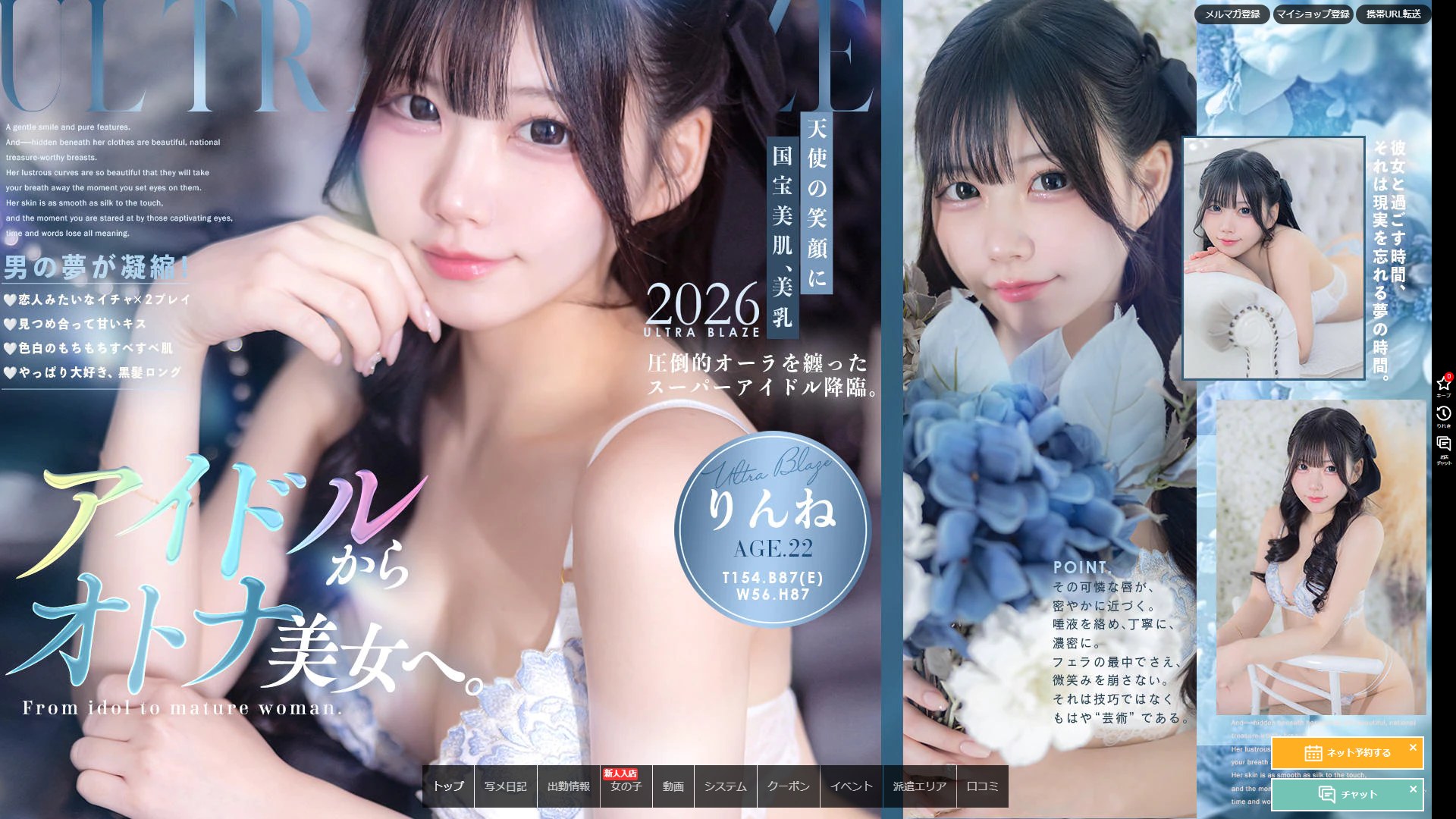
The character of Ultra Blaze comes clear in the single line they put at the top: "the dream resort health that fulfills the desires of every man on earth." In other words — not just another Kinshicho delivery health (deriheru — a girl sent to your hotel), but a declaration that they're packaging and selling the extraordinary thing called a "resort."
Let me stop here a second. In fuzoku, "resort" is one of the hardest signifiers to verify, because a resort isn't a place — it's a mood. You don't need a seaside hotel; if you can cut the customer's head loose from reality, that's a resort. Conversely, no matter how much you puff up the words, if any "everyday life" residue clings to the path from the front desk to the end of the session, the customer never feels like he went to a resort at all. The bigger the words on the sign, the higher the risk the gap makes it all look cheap. Twenty years of watching, and shops with this kind of concept split on one axis: has the operation caught up to the words?
Kinshicho as a neighborhood, and what "free dispatch" really means
It's in Sumida Ward, Kinshicho. The nearest stop is the Kinshicho Station south exit; hours run 9:00 a.m. to 5:00 a.m. Dispatch to the Kinshicho hotel district is free, and their coverage runs across Tokyo's 23 wards plus Urayasu and Ichikawa in Chiba — a fairly wide footprint for a delivery health.
Picking Kinshicho fits this concept well. The neighborhood has both volume and a wide price range on hotels, and the line from the station's south exit to the hotel district is short. The smaller the lag between the guy checking into a hotel and the girl arriving, the less time he spends thinking "I called and now I'm waiting, and I'm back in reality." A resort "mood" breaks easily on dead waiting time, so designing the free-dispatch zone to overlap the hotel district is a quiet but effective move to keep the sign from being a bluff.
How to read the pricing and coupons
The standard price is ¥23,100 for sixty minutes. Use the official coupon and it drops to ¥18,100 — about a 22% discount. On top of that there was a notice offering up to ¥5,000 off as a first-timer discount. For a high-end Kinshicho delivery health, that's a price you count from the top down.
What caught my eye in this pricing was the landing spot of ¥18,100 after the discount. Left at the standard ¥23,100, the clientele narrows to regulars who've completely bought into the "resort." But at ¥18,100, the crowd that wants to try a step up in Kinshicho can reach for it. They fly a premium concept while using the coupon to bring that first visit down to a realistic line — in other words, the pricing is designed to "let you feel the resort on the first visit, then carry you onto the standard price on repeats." For a concept shop, that's sound. The flip side: if they can't make you feel the resort on that first visit, the pricing falls apart. That, I figured, was the core thing to test.
A roster topping 5,000 and reconciling it with "hand-picked"
The number this site lists as its roster is on another order of magnitude. Some of it is probably group totals stacked together, but even so, "beauties hand-picked from across the country" as a hiring concept and this enormous denominator look, at a glance, contradictory. "Hand-picked" and "mass roster" are usually words that don't coexist.
That said, my view shifted a little when I called to check who was working that day and to ask about personalities. The desk narrowed it down concretely — "girls on shift right now who fit the resort concept" — and named a few. With a huge-roster shop, the thing to fear is a desk that can't keep track of inventory and punts with "just pick from the photos." This one didn't; they could filter the giant denominator by what I wanted. If they can run a mass roster as breadth of choice, then it does reach a rough peace with the word "hand-picked."
Options and the design logic of the "set discount"
The options on offer were tool-type — Womanizer, electric massager, rotor — with a notice that ordering them as a set gets you a discount. The concept's consistency shows here too.
For a shop that calls itself a resort, the options should by rights be "props that make you forget reality." Add them one at a time, single-item, and the customer ends up thinking about the bill, snapping slightly back to reality each time. Bundle them into "the extraordinary, all at once" with a set discount, and he's freed from doing arithmetic and can sink into the experience. Binding options not as "billing points" but as "part of the world" is coherent against the resort sign.
My read: if you want to max out the resort feel here, give yourself more time than just sixty minutes and load the options up front as a set. A mid-session add-on negotiation breaks the immersion you paid for. Decide everything at the start, then forget reality — that, I think, is the correct way to play this concept.
The "temperature of the extraordinary," seen from time spent with her
What I wanted to confirm with the girl who actually came was whether the word "resort" is shared on her side too. In a shop where the concept is sign-deep only, the girl walks in in ordinary customer-service mode and the customer is stuck building the world solo. That doesn't make for the extraordinary.
On that score, the way she handled the first few minutes after entering was different from your usual transactional delivery health. Instead of rushing into the choreography, she spent time loosening the air first. That was the moment I felt they could translate the resort concept into "an unhurried flow of time." The temperature of the conversation, too, didn't slam the distance shut all at once — it rose a little at a time over the visit, proof that the shop's intent to "stage the extraordinary" has filtered all the way down to the floor.
Grooming and cleanliness were at a level worthy of calling itself a high-end shop; if that collapses, "resort" goes cheap in a heartbeat. That they didn't miss that baseline is something I'll credit honestly. Not perfect so much as: the floor is earnestly rising to meet the concept.
How to read the "Top 100 Shops" outside evaluation
The site flags that it's been selected for the "Top 100 Shops" every year from 2024 to 2026. I don't swallow this kind of outside evaluation whole, but I don't ignore it either. Several years running is a sign of sustained operational base strength, not a one-time fluke. A concept that sells "quality of experience," like a resort, is hard to maintain in a delivery health with heavy girl turnover. Holding it across several years is at least corroborating evidence that the back-office operation is stable.
The verdict
| Item | Rating |
|---|---|
| Build-out of the "resort = extraordinary" through-line | ★★★★☆ |
| Desk's filtering / roster command | ★★★★★ |
| Overlap of free-dispatch zone and hotel district | ★★★★★ |
| Coupon-inclusive entry-point value | ★★★★☆ |
| Set design of the options | ★★★★☆ |
| Continuity of outside evaluation (Top 100) | ★★★★☆ |
While most shops that call themselves "resort" stop at words-first, Ultra Blaze had quietly but genuinely stacked the "don't let him return to reality" through-lines — wait time, dispatch zone, option bundling, desk filtering. The standard ¥23,100 for sixty minutes isn't cheap, but use the coupon entry point that drops it to ¥18,100 and the math works as a first stop for trying a step-up extraordinary in Kinshicho. Counting the fact that they handle the enormous roster as "breadth of choice," I rate this a high-end delivery health where the concept and the operation don't badly diverge.