
Kinshicho on a Sunday in August is the least glamorous good night out in Tokyo. The station spits you into an intersection of pachinko halls and chain izakaya, Marui on one side, the Sky Tree standing over the whole thing like a hall monitor, and none of it is trying to impress you. I like it for that. It is the last major pleasure district in this city that has not been redeveloped into a lifestyle brand.
I came for Tokyo Joshidaisei Grand Prix — Tokyo Female University Student Grand Prix, which is exactly as subtle as it sounds — a delivery health (deriheru: a legal dispatch service where a woman comes to your hotel room or home, and where penetrative sex is prohibited by law and by the shop's own posted rules). The Kinshicho branch. Listed on Cityheaven as a standard-class deriheru, running around the clock, dispatching to love hotels, business hotels and private addresses across all twenty-three wards.
I'd already written up this group's other branch years ago, and the piece was, in retrospect, useless — a lot of atmosphere about a "dense sixty minutes" and nothing a person could act on. So this time I did the homework before I picked up the phone. The homework turned out to be the story.
The concept page says the quiet part in full paragraphs
Shops in this industry lie mainly by omission. This one publishes a policy document, and it is startling.
They recruit, they say, not through the usual job boards but through a private network — university contacts, student communities, word of mouth between friends. The hiring bar is stated as not being tainted by the industry: looks matter, but so does the absence of prior experience. The badge on the price poster reads 素人率100% — one hundred percent amateur.
And then this, which I read three times to be sure:
講習は一切なし。 — No practical training whatsoever.
Verbal explanation only. No walkthrough, no coaching, no house technique. The stated reasoning is that a manual would flatten the thing the customer is actually here for: a woman who doesn't yet know what she's doing, visibly trying. The page closes with a direct request to customers — the women are one hundred percent new to this, they'll arrive nervous, they will sometimes get it wrong, and that's part of the charm, so please be kind and smile.
Put the marketing aside and read it as a business document. The product is not a service. The product is a person's first few weeks. Everything else on the site is downstream of that sentence.
Three campaigns, one idea
All three of the shop's current promotions went up the day I visited. Look at what each one actually buys.
| Campaign | What you get | What you give up |
|---|---|---|
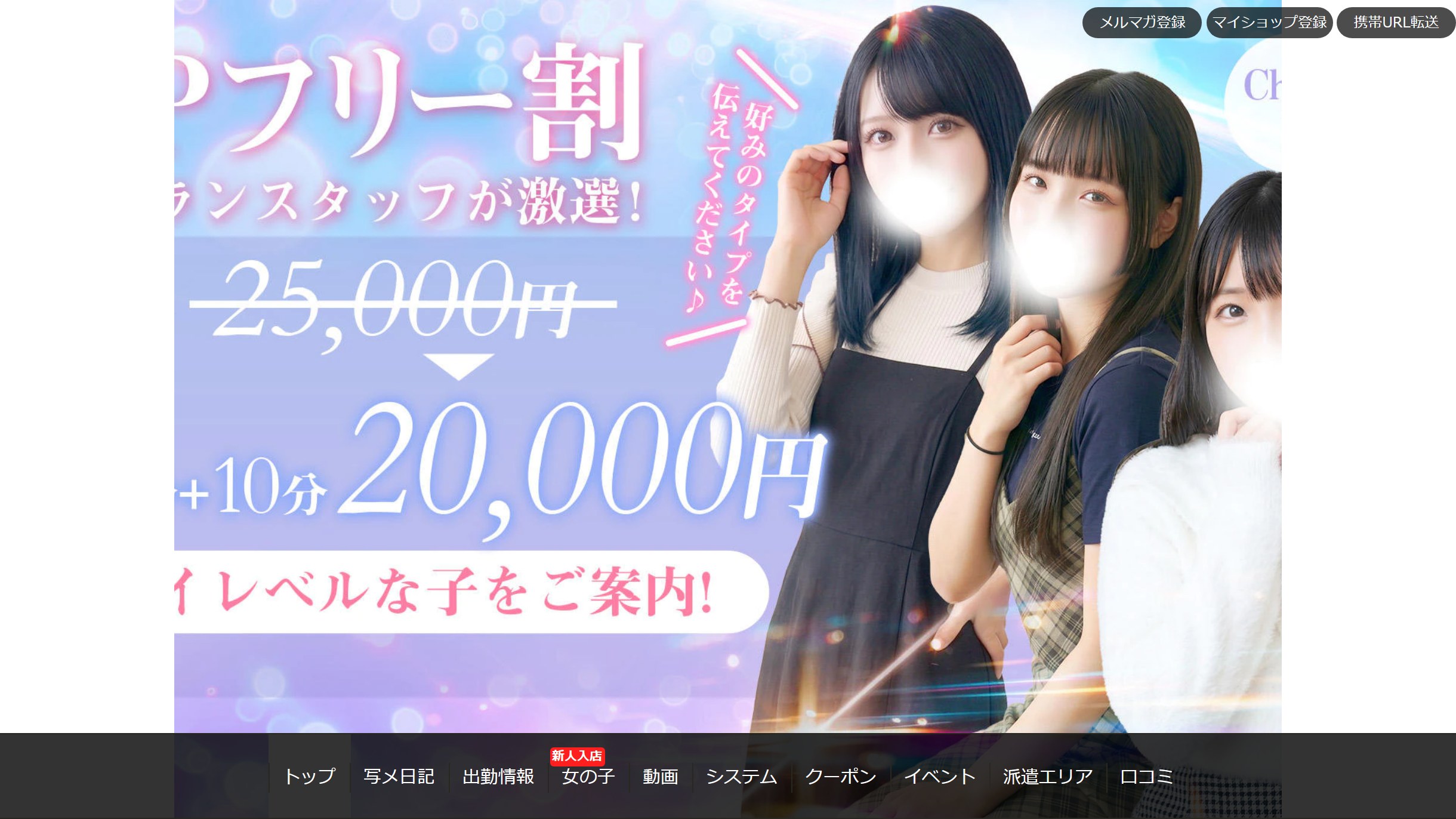
| GP Trial Free-Select | 70 min for ¥20,000 instead of 60 min at ¥24,000, transport included (also 85 min ¥25,000, 100 min ¥30,000) | Free booking only — you don't choose, the desk chooses |
| New Student Discount | ¥3,000 off the total | She's within one month of joining, so there's nothing to go on |
| Review Discount | ¥2,000 off | You write the review — during the session for cash back on the spot, or afterwards for ¥2,000 off next time |
Three discounts, and every one of them is a subsidy on a different kind of ignorance. The first pays you not to pick. The second pays you to pick someone with no history. The third pays you to manufacture, after the fact, the information that didn't exist when you booked. The shop will stack the second and third.
That's not a criticism, exactly. It's a coherent machine. But it does mean the usual method — read the reviews, pick well, pay a bit more — has been quietly dismantled before you arrive.
132 women, 31 reviews
Here's the part that made me put my coffee down. The roster page reports 132 women on the books. The site displays the first hundred. I counted what's attached to them.
| Reviews on a profile | Number of women (of the 100 shown) |
|---|---|
| None | 78 |
| One | 19 |
| Two | 2 |
| Three | 1 |
Seventy-eight of a hundred have no customer review at all. Shop-wide the review section holds 31 entries total — for a roster of 132. And remember the shop is paying ¥2,000 a head for those reviews. That is what a ¥2,000 bounty buys here: less than one review for every four women.
The ages fill in the rest of the picture. Of those hundred profiles: 33 are eighteen, 40 are nineteen, 23 are twenty, and 4 are twenty-one. Seventy-three percent are eighteen or nineteen.
And the turnover is quick. The "new arrivals" panel lists ten women, and the ten most recent entries are dated 3 August to 16 August — the newest of them started the morning I was reading the page.
Stack those three numbers and the review drought stops being a mystery. Nobody accumulates a reputation, because the tenure required to accumulate one is longer than the average stay. The shop isn't hiding its track record. There genuinely isn't one to hide, and the structure of the business guarantees there never will be.
The reviews that do exist are worth a paragraph of their own. They cluster on a handful of names, they come from high-volume reviewers with eighty-plus posts and a following, and every single shop reply beneath them is the same block of copied text down to the punctuation. A couple read oddly — four florid paragraphs about a woman's inner radiance, followed by a two-word overall verdict. When you pay ¥2,000 per review, you get ¥2,000 reviews. Treat that section as advertising with a byline, not as data.
What it actually costs
The price sheet is refreshingly plain, and there are two tiers.
| Course | Casual Class | Grand Prix Class |
|---|---|---|
| 60 min | ¥18,000 | ¥22,000 |
| 75 min | ¥22,000 | ¥27,000 |
| 90 min | ¥26,000 | ¥32,000 |
| 120 min | ¥34,000 | ¥42,000 |
| Extension, 30 min | ¥12,000 | ¥16,000 |
On top: nomination ¥2,000, or ¥3,000 to request someone you've already met. Transport is free on foot from Kinshicho Station, ¥2,000 to anywhere else in the 23 wards, ¥3,000 and up beyond that. Options run ¥2,000–¥4,000. The room is not included, and in this district that's another ¥5,000-ish for a few hours.
Now check that against what customers reported paying. The five most recent reviews list totals of ¥20,000, ¥22,000, ¥22,000, ¥24,000 and ¥25,000 for sixty minutes, room excluded — visits between 29 July and 12 August. Those numbers reconcile exactly: base course plus a nomination fee. Nobody is being ambushed at the door, which is more than I can say for a lot of places within walking distance of where I was standing.
Realistic all-in for a first visit: ¥25,000–¥30,000 for an hour once you've added the room and the trip. The advertised ¥18,000 is a floor, not a forecast. There's also a phone-only coupon at ¥15,000 for sixty minutes if you're hosting at your own address — limited numbers, and I couldn't verify availability, so treat it as a lottery ticket rather than a plan.
Receipts on request, cards accepted, and the shop states its name doesn't appear on the statement. Say "Heaven mita" — I saw it on Heaven — when you call, or none of the campaigns apply.
Sunday, 13:05
Sixteen women were listed as available immediately when I loaded the page that afternoon. Sixteen, on a Sunday, at one in the afternoon. That is not a shop struggling for staff; it's a shop with more supply than Sunday lunchtime demand, which is precisely the condition that produces a free-select discount.
The shift board that day started early — a cluster of women on from 6:00, most of them running to mid-afternoon, the latest starts around noon. The listing claims 24-hour operation; what I could actually see rostered was a long daytime spread, with photo-diary posts timestamped at 01:44 and 05:04 suggesting the overnight is thinner but real. If you want the small hours, ring and confirm rather than assuming.
I called. The desk was quick, unbothered, entirely professional — the tone of people who take a lot of calls and have no interest in overselling. I asked the two questions worth asking at a shop like this: how new is she, and has she done a shift before today. Both answered straight, no hedging, no upsell into the higher tier. I booked the Grand Prix hour with a nomination — ¥24,000 before the room — and skipped the free-select promotion, which cost me ¥4,000 and ten minutes on purpose. I'll come back to why.
She arrived four minutes early, which almost never happens, and apologised for it, which never happens.
I'm not going to file a physical account; that isn't what this column is for and it isn't what the shop is selling anyway. What I'll say is that the no-training policy is not a marketing fiction. You can tell. There's no sequence being executed, no sense of a routine reaching its next scheduled beat, none of the low-grade autopilot that the seasoned end of this industry runs on. What replaces it is someone genuinely paying attention to you because she has no script to fall back on, and asking, out loud, whether things are alright — which is disarming for about ten minutes and then simply pleasant.
The flip side is exactly what you'd predict. Pacing is uneven. Nerves are visible. The hour has no architecture to it; it's a conversation that goes where it goes. If your idea of value is technical polish, you are paying Grand Prix money for the opposite of it, and you will feel robbed. That's not the shop failing to deliver. That is the shop delivering precisely what it advertised on the front page, and it's the reason I'd steer a first-timer to a different kind of house entirely.
Say the obvious thing out loud
A business whose product is a person's first month deserves to be described accurately rather than winked at. Three-quarters of this roster is eighteen or nineteen, the marketing leans hard on that, and the house policy of giving them no training is presented as a feature for the customer. Whatever else that is, it puts the burden of the encounter going well on the man in the room — a burden the shop names explicitly, in writing, in its request that you be kind about the mistakes.
To the shop's credit, the rules are posted and they're not soft: no under-18s, penetrative sex prohibited and coercing it grounds for removal, no scouting, no arranging to meet outside the shop, no photography or recording, shower before play, and a stated willingness to involve the police. It's a registered operation under the entertainment-business law and it reads like one.
So: legal, licensed, and up-front about what it is. Just don't tell yourself you're buying a service. You're buying someone's third-ever shift, and the whole price structure exists to make you comfortable with not knowing which shift it is.
About the shop
Delivery health, Kinshicho, Sumida-ku, Tokyo. Tel 03-6709-1288, listed as operating 24 hours. Dispatch to love hotels, city hotels and private residences throughout Tokyo's 23 wards; transport free within walking distance of Kinshicho Station, ¥2,000 elsewhere in the 23 wards, ¥3,000+ beyond. Two classes: Casual from ¥18,000/60 min, Grand Prix from ¥22,000/60 min, extensions ¥12,000 and ¥16,000 per 30 min. Nomination ¥2,000, repeat nomination ¥3,000. Options ¥2,000–¥4,000. Room not included. Cards accepted, receipts available, shop name withheld from card statements. Roster of 132; ages 18–21. Campaigns as of 16 August 2026: GP Trial Free-Select (70 min ¥20,000, free booking only, transport included), New Student Discount (¥3,000 off, cast within one month of joining), Review Discount (¥2,000, stackable with the above). Mention "Heaven mita" when calling.
The verdict
| Item | Rating |
|---|---|
| Honesty of the concept page (rare, and total) | ★★★★★ |
| Price transparency (reviews reconcile to the sheet) | ★★★★★ |
| Roster depth and immediate availability | ★★★★★ |
| Desk handling (fast, straight, no upsell) | ★★★★☆ |
| Usable customer information (78 of 100 have none) | ★☆☆☆☆ |
| Technical polish, by explicit policy | ★☆☆☆☆ |
| Overall | ★★★☆☆ |
Three stars, and I mean it as a genuine recommendation to a narrow audience rather than a shrug. This shop does one thing, states plainly that it does one thing, prices it consistently, and doesn't pretend the reviews mean anything. If what you want is somebody who is good at this, walk five minutes in any direction from Kinshicho Station and you'll find a shop that will sell you that for the same money.
If what you want is the other thing — the unpolished, unscripted, slightly nervous hour that the entire Japanese sex industry gestures at with the word amateur and almost never actually supplies — this is the rare place where the claim survives contact with the invoice.
Book Grand Prix, pay the nomination fee, ask how many shifts she's worked, and don't take the free-select discount. The ¥4,000 you save is the ¥4,000 you needed to spend.