
Kichijoji is the town Tokyo keeps voting as the place it would most like to live, and it has the smugness to match. Inokashira Park at the south end with the swan boats and the buskers. Harmonica Yokocho at the north, six alleys of eight-seat bars wedged into a postwar black-market footprint that somebody had the sense never to bulldoze. A department store, an art-house cinema, a shopping arcade full of people carrying baguettes. Twenty minutes from Shinjuku on the Chuo line and about four hundred kilometres from it in temperament.
What Kichijoji does not have is a red-light district. There's no Kabukicho block here, no Yoshiwara strip, no rows of illuminated boards with women's faces on them. The neighbourhood would not stand for it — and it doesn't have to, because the modern version of this industry doesn't need a street. It needs a phone number and a hotel within walking distance of the station.
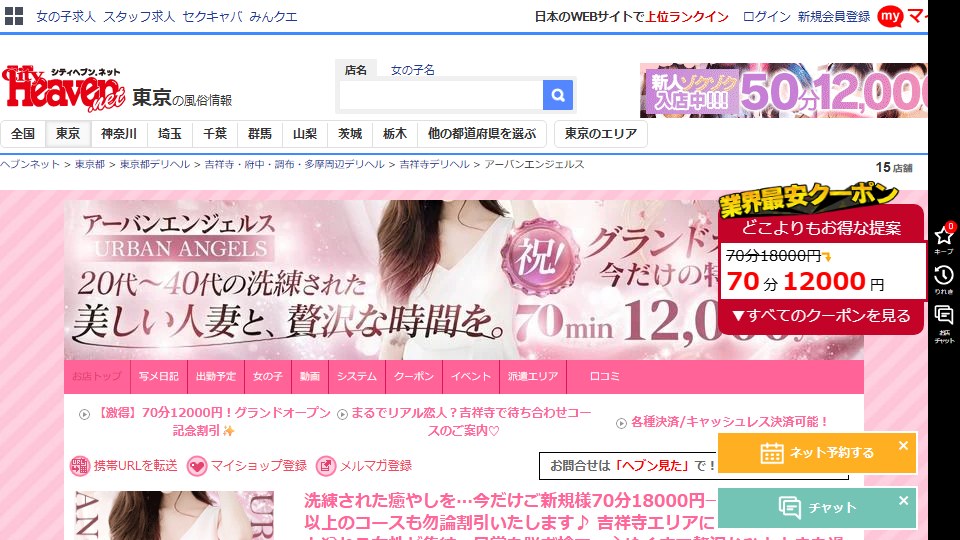
Which is how I ended up reading the price sheet for Urban Angels — アーバンエンジェルス, a deriheru (delivery health: a licensed dispatch service where a woman comes to your hotel room or residence, and where penetrative sex is prohibited by law and by the shop's own posted rules) billing itself as a married-woman specialist, operating 14:00 to 05:00, no closed days, out of Musashino City.
It opened about six weeks ago. That turns out to be the whole story.
How I know how old it is
Nobody publishes an opening date. You can usually infer one, and here the inference is clean: the earliest customer review on the shop's page is dated 4 July 2026, and the price board still carries a campaign labelled grand opening, capped at the first hundred new customers.
Six weeks old, then, give or take. A newborn — but not an independent one. This is a branch of the Angel group, and the loyalty scheme it runs is explicitly usable across the group's other shops. The Cityheaven navigation for the group lists fifteen affiliated locations. So: a new storefront with an old company behind it, which is a very different risk profile from a genuine start-up, and it shows in how the pricing is built.
Two price boards, and only one of them matters
Here is the standard sheet.
| Course | Price | Per minute |
|---|---|---|
| 70 min | ¥18,000 | ¥257 |
| 100 min | ¥23,000 | ¥230 |
| 130 min | ¥28,000 | ¥215 |
| 160 min | ¥33,000 | ¥206 |
| 190 min | ¥36,000 | ¥190 |
| Extension, 30 min | ¥8,000 | ¥267 |
Textbook. The curve slopes down; length is rewarded; the shortest course is the worst value per minute. Now the grand-opening sheet, new customers only, first hundred.
| Course | Opening price | Per minute | Saving |
|---|---|---|---|
| 70 min | ¥12,000 | ¥171 | ¥6,000 |
| 100 min | ¥20,000 | ¥200 | ¥3,000 |
| 130 min | ¥25,000 | ¥192 | ¥3,000 |
| 160 min | ¥30,000 | ¥188 | ¥3,000 |
| 190 min | ¥33,000 | ¥174 | ¥3,000 |
Look at what happened. Every course above seventy minutes gets a flat ¥3,000 off — a rounding error at the long end, eight percent on the 190. The seventy gets ¥6,000, a third of its price, and lands at ¥171 a minute: the cheapest rate anywhere on either board, undercutting even the three-hour course.
The curve doesn't just flatten. It flips. For a hundred customers, this shop is paying you to take the short course, which no shop ever does, because the short course is where the margin lives.
It isn't generosity and it isn't confusion. A six-week-old branch has one problem — an empty ledger — and the fastest fix is volume of first visits, not depth of individual ones. Every ¥12,000 hour is a name in the database and a shot at a review on a page that badly needs them. The ¥6,000 is an advertising spend that happens to be shaped like a discount.
The practical read for anyone standing where I was standing: take the seventy. If you take the 190 under this campaign you are paying ¥33,000 to save ¥3,000 on a shop you have never used, run by people you have never met, with a roster you'll see in a minute. And when the hundred are gone, the seventy reverts to being the worst-value box on the sheet.
The extension is a fine for indecision
One more thing buried in the arithmetic. Each additional thirty-minute block, bought in advance as the next course up, costs ¥5,000 — 70 to 100, 100 to 130, 130 to 160. The final step, 160 to 190, costs ¥3,000.
Extending in the room costs ¥8,000 for the identical half hour.
So the shop charges a ¥3,000 premium — sixty percent — for the same thirty minutes if you decide late. That's not unusual in this industry, but it's rarely this stark, and it's the one number on the board that will actually cost you money if you ignore it. Decide before you dial. If there's any real chance you'll want longer, the hundred is ¥5,000 more up front and ¥8,000 more from the bed.
Nine women. Not one thousand three hundred.
The group's page throws a big number around — something over 1,300 women across all fifteen shops. It's the kind of figure that makes a chain look like an ocean. The branch you are actually calling has, as of this afternoon, nine women on its roster.
Ages: 23, 24, 25, 26, 28, 29, 31, 40, 40. Four of the nine carry a 新人 — new arrival — badge.
Two observations, and the second one is the useful one.
First, the "married woman specialist" framing is doing a lot of work. Two forties, a thirty-one, a couple in their late twenties — fine. But the two women carrying most of this shop's reputation are twenty-three and twenty-four. If you're specifically here for the hitozuma thing, understand that the label describes the shop's marketing category, not a guarantee about who picks up the shift.
Second, and this is where a nine-woman roster gets interesting: I counted the reviews attached to each profile.
| Woman | Reviews |
|---|---|
| Ayaka (23) | 9 |
| Akari (24) | 8 |
| Mari (40) | 3 |
| Yuki (25) | 2 |
| Shiho (40) | 1 |
| The other four | 0 |
Twenty-three reviews total, which matches the shop-wide count exactly. Two women account for seventeen of them — seventy-four percent. Four of nine have no customer feedback at all.
At a 130-woman shop that distribution would be meaningless noise. At a nine-woman shop it's a map. Almost everything anyone has written about this place is about two people, both of them at the young end of a roster sold on maturity. If you book anyone else, you are the review.
What people are actually paying
This is the part I always check, because a price board is a claim and a receipt is evidence. Ten reviews list a course and a total. Nine of them are seventy-minute bookings.
Reported totals, room excluded: ¥10,000, ¥11,000, ¥11,000, ¥13,000, ¥15,000, ¥15,000, ¥17,000, ¥18,000, ¥18,000. Visits from 4 July through 14 August. Median: ¥15,000.
Against a ¥18,000 list price, only two customers of nine paid it. The rest landed at or below the ¥12,000 opening rate plus a fee or two. Which tells you the campaign is real and being applied, not a banner hung over a price nobody discounts. It also tells you the sub-¥12,000 entries have a coupon in them somewhere I can't see from here — the ¥10,000 doesn't reconcile to any published combination, so don't build a budget on it.
One oddity worth flagging: a review from 1 August lists a sixty-minute course at ¥11,000. There is no sixty-minute course on the current sheet. Either the board has been revised in the six weeks since opening, or a phone-only option exists that isn't published. Either way, ask.
Now the honest all-in. Seventy minutes at the opening rate, ¥12,000. Net reservation fee ¥1,000. Designation ¥1,000 if you're asking for someone specific — and given what the review distribution looks like, you are. Transport is free to a Kichijoji hotel, ¥1,000 to your own place or out to Mitaka, Ogikubo and Nishi-Ogikubo, ¥2,000 for Kokubunji, Suginami, Nakano, Setagaya, Nerima or Chofu, ¥3,000 and up beyond. The room is yours to sort out, call it ¥5,000–¥7,000 near the station for a rest.
Realistic first visit: ¥19,000–¥21,000 all in. After the campaign ends, the same evening is ¥25,000–¥27,000. That gap is the entire reason to go now rather than in October.
Options run ¥1,000 to ¥10,000 and are itemised on the site with no coyness about it. Three are free with advance notice. Cards are accepted.
The points are a leash, and a fair one
Angel Points: 5% of what you pay comes back as points, ¥1,000 in points equals ¥1,000 off, minimum ¥1,000 per redemption, auto-enrolled on your first visit. Redeemable across the group's shops.
The cap is the interesting bit. Points you can apply to a single booking are limited by course length — ¥1,000 on the seventy, rising to ¥5,000 on the 190. Do the loop: a ¥14,000 visit earns ¥700. You need two visits to clear the ¥1,000 minimum, and on a seventy-minute course you can only spend ¥1,000 at a time. The balance never empties in one go; it always leaves a reason to come back.
I don't say that as an accusation. Five percent is five percent, it's plainly stated, and it beats most loyalty schemes in this industry, which are usually a stamp card and a lie. Just be clear about what it's for: it isn't a discount on this shop, it's a bond to the chain. The group is buying your next fourteen visits with the change from this one.
The call, and the hour
I rang at half past four. Fifteen minutes to seven in the evening in a town where the last train back to Shinjuku is not a crisis, so no pressure either way.
The desk was brisk and slightly under-rehearsed, which I mean as a compliment — six weeks in, nobody has developed the smooth patter yet. Say "Heaven mita" — I saw it on Heaven — when you call; it's printed on the shop's own header and it's the phrase that makes the campaign apply. I asked whether the opening rate held with a designation. Straight answer, no manoeuvring toward a longer course, no invented scarcity. I booked seventy minutes with a nomination, paid the reservation fee, and took a hotel three minutes from the north exit so the transport came to nothing.
Read the cancellation policy before you commit, because it is one line and it is not soft: no changes, no cancellations. In a district where you might be waiting on a friend's dinner to end or a train to behave, that's a genuine constraint. Book when you're certain.
I'm not going to file a physical inventory; that isn't what this column does, and it isn't the part that varies. What I'll say about the hour is that a six-week-old branch feels like a six-week-old branch, and mostly in good ways. Nobody is bored yet. The arrival was on time, the woman knew what the shop had promised on her profile and had clearly read it herself — the site makes a point of the phrase プロフィールの嘘・偽りは一切なし, no lies or falsehoods in the profiles, and on the evidence of one visit that held. There was none of the assembly-line compression you get at a big Kabukicho house where the desk is stacking dispatches.
What you don't get is depth of bench. Nine women, four of them brand new, on a shop that runs fifteen hours a day. If your first choice isn't on shift, your second choice may not exist. Check the schedule before you build an evening around this.
The rules, posted plainly
To the shop's credit the prohibitions are published and unambiguous: customers must be 18 or over, penetrative sex is prohibited, no violence or harassment, no theft, no scouting or recruiting the staff, no drug use, no organised-crime affiliation, no intoxicated customers, no third parties present, and no changes or cancellations once booked.
That's a licensed operation under the entertainment-business law describing itself accurately, and the two rules people actually break — showing up drunk, and pushing for what the licence doesn't cover — are both on the list in writing. Read them as the terms of a contract, because that is what they are.
About the shop
Delivery health (deriheru), married-woman concept, Kichijoji, Musashino City, Tokyo. Tel 03-6555-8688. Open 14:00–05:00, no regular closing day. Courses ¥18,000/70 min, ¥23,000/100, ¥28,000/130, ¥33,000/160, ¥36,000/190; extension ¥8,000 per 30 min. Grand-opening rate for the first 100 new customers: ¥12,000/70 min, ¥20,000/100, ¥25,000/130, ¥30,000/160, ¥33,000/190. Net reservation fee ¥1,000, designation ¥1,000, entry fee free. Transport free to Kichijoji hotels, ¥1,000 to a private residence or to Mitaka/Ogikubo/Nishi-Ogikubo, ¥2,000 to Kokubunji/Suginami/Nakano/Setagaya/Nerima/Chofu, ¥3,000+ elsewhere. Room not included. Options ¥1,000–¥10,000, three free with advance notice. Angel Points 5% cashback, redeemable across the group's shops, per-booking cap scaled to course length. Cards and cashless accepted. Mention "Heaven mita" when calling. Roster of 9 as of 16 August 2026, ages 23–40, four marked as new arrivals; 23 customer reviews shop-wide. One of fifteen shops in the Angel group. No changes or cancellations.
The verdict
| Item | Rating |
|---|---|
| Opening-rate value on the 70 (¥171/min) | ★★★★★ |
| Price transparency (receipts reconcile to the board) | ★★★★★ |
| Desk handling — direct, no upsell | ★★★★☆ |
| Options and fees itemised without coyness | ★★★★☆ |
| Loyalty scheme (real 5%, but it's a chain leash) | ★★★☆☆ |
| Roster depth — nine women, fifteen-hour day | ★★☆☆☆ |
| Usable customer information (2 women = 74% of reviews) | ★★☆☆☆ |
| Cancellation policy (none, at all) | ★☆☆☆☆ |
| Overall, during the campaign | ★★★★☆ |
| Overall, after the campaign | ★★★☆☆ |
Two scores, because there are honestly two shops here and the difference between them is a hundred customers deep.
Right now Urban Angels is selling the cheapest legitimate hour in Kichijoji and doing it without a single piece of sleight of hand on the invoice — the price board says one thing, nine strangers' receipts say the same thing, and the woman who arrived matched the photographs. In a business where the gap between the advertisement and the door is usually the whole review, that counts for a great deal.
But nothing about the ¥12,000 is durable. It's a marketing line item with a counter attached to it, and when the counter hits a hundred you're looking at a nine-woman roster, a ¥257-a-minute short course, a ¥8,000 extension penalty and a no-cancellation policy, in a town twenty minutes further out than the competition.
Go while the arrow is pointing the wrong way. That's the entire recommendation, and I'd rather give you one that's true for six weeks than one that's vague forever.